#9 Favorite
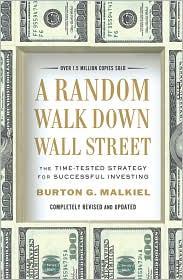
A Random Walk Down Wall Street: The Time-Tested Strategy for Successful Investing
I borrowed A Random Walk Down Wall Street by Burton Malkiel from my roommate, who was assigned it for a class and (sadly) never finished it. He should have. This is the kind of book that every young person needs to read, especially in an era where most people my age would rather get rich quick on the next meme stock than build wealth slowly. Malkiel is a Princeton economist who first published this book in 1973, and the core argument has held up so well that he is now on the 13th edition, released in 2023 for the 50th anniversary. One of the strongest things you can say about any book is that it has withstood the test of time, and A Random Walk Down Wall Street certainly has.
The book is built on the Efficient Market Hypothesis, or EMH, which says that the price of a publicly traded stock already reflects all publicly available information about it. By the time you read about a company in the news, see a chart pattern, or hear about a great quarter, that information is already baked into the price. Which means that as an individual investor without some kind of edge, you are not really analyzing a stock when you buy it. Instead, you are just guessing.
The piece that does not get talked about enough is just how brutal the math of picking individual stocks actually is. There is a fantastic study by an Arizona State professor named Hendrik Bessembinder that looked at every US common stock from 1926 to 2016. He found that the majority of individual stocks delivered worse lifetime returns than one-month Treasury bills. In other words, most individual stocks did worse than basically holding cash. More than half delivered negative lifetime returns. The kicker is that just 4 percent of listed companies accounted for all of the net wealth creation of the entire US stock market over those 90 years. The other 96 percent collectively matched Treasury bills. A more recent global version of the study found that just 2.4 percent of firms accounted for all of the $75 trillion in global stock market wealth creation between 1991 and 2020. What this means in practice is that if you pick a stock at random, you are far more likely to pick a loser than a winner, and all of the upside of the market comes from a tiny handful of companies that you would have to identify in advance. Indexing solves this by guaranteeing you own all of them.
The book is kind of frustrating in the best way. Almost every chapter walks you through a different investment strategy, whether it is technical analysis, charting, momentum trading, day trading, or some flavor of fundamental analysis. You read it, it makes intuitive sense, you start to feel like you are going to figure out the market, and then at the end of the chapter Malkiel shows you the data and tells you that this strategy performs worse than just buying a passively managed broad based index fund. After about the third or fourth chapter, you start to get the message. The market is hard to beat, and almost everyone who claims they can beat it is either lucky, lying, or about to lose.
Here is the wild part. When Malkiel published the first edition in 1973, index funds for regular people did not even exist. He spent that edition arguing that someone should create one, and three years later Jack Bogle launched the First Index Investment Trust at Vanguard. It was so unpopular at the time that it was nicknamed “Bogle’s Folly.” Today there are trillions of dollars in index funds and they are the default recommendation for almost any serious investor. Malkiel was right about something that the entire financial industry told him was wrong, and the market eventually came around. That is a level of intellectual vindication most authors never get to see.
The EMH is not perfectly true. The most famous counterexample is Renaissance Technologies’ Medallion Fund, which has earned something like 39 percent annualized returns after fees since 1988. That is the longest, most consistent market-beating track record in history. They employ hundreds of PhDs in math, physics, and signal processing, and they have found patterns in market data that no one else can. But here is the thing that gets missed about Medallion. They are not picking winners with confidence. They are right on only about 50.75% of their trades, according to one of their senior managers. Their entire edge is a coin flip that is microscopically tilted in their favor, multiplied across millions of trades per year with enormous leverage and tiny transaction costs. As that same manager famously put it, “We’re right 50.75% of the time, but we’re 100% right 50.75% of the time.” The fund has been closed to outside investors since 1993 and only employees of Renaissance can hold it. So it is true that the market is not perfectly efficient. But Medallion is practically the exception that proves the rule. If beating the market consistently required hundreds of PhDs, billions in infrastructure, and a 50.75% win rate exploited at industrial scale, then for everyone else the practical conclusion is to just buy the index and move on.
One of my favorite ideas in the book is that indexing can reduce your risk without reducing your reward, at least up to a point. When you buy a broad market index fund, you are diversified across hundreds or thousands of companies. The risk that any single company tanks and wipes out your portfolio is essentially gone. What remains is the risk that the market as a whole goes down, which you cannot diversify away. But that systematic risk comes with the long term expected return of the market, which historically has been good. Diversification gets you most of the way to safety without costing you the upside.
I also think the book makes a really important distinction between investing and speculating, even if Malkiel does not always frame it in those terms. Investing is buying assets with the expectation of long term growth, based on the underlying productivity and earnings of the businesses you own. Speculating is betting that the price will go up because you think you can predict the next move. Most of what young people call investing today is actually speculating. Buying a meme stock because it is trending, buying a crypto coin because someone you follow posted about it, day trading options based on a chart pattern. None of that is investing. It might work in the short term, and it might even feel like skill when it does, but over time speculation is closer to gambling than wealth building.
The clearest modern example of this is prediction markets like Polymarket and Kalshi. Young people are getting roped into these platforms by founders who boast about how the “wisdom of the crowd” can predict the future better than any expert. The pitch sounds great. You can bet on elections, geopolitical events, sports outcomes, basically anything that has a resolvable answer. And the markets really do seem to be eerily accurate. But here is what’s important to know. The economist Robin Hanson, who built the academic theory that prediction markets are based on, openly says that the model only works if insiders are participating. Without insiders trading on private information, a prediction market is just a poll with a betting button. So when founders brag about how accurate their platforms are, they are quietly admitting that the markets are being driven by people who know more than you do. And the receipts are stacking up. A U.S. Army soldier was recently charged with using classified intelligence to bet $33,000 on the capture of the Venezuelan president, and turned it into roughly $400,000. Political campaign staffers have been busted for betting on their own candidates ahead of unreleased polls. A Wall Street Journal analysis found that 67 percent of all profits on Polymarket go to just 0.1 percent of accounts. This is the same EMH logic playing out in real time. If the price already reflects information you do not have, you are not predicting. Instead you are guessing while someone else already knows. Compare that to broad based index funds. With index funds, you are not betting on team A or team B. You are betting that as time goes on, both team A or team B will get better, and the global economy as a whole will be more productive thirty or forty years from now than it is today. That is a bet you can actually win.
One thing worth flagging that Malkiel does not really get into. When you buy an ETF or a mutual fund, you are technically the beneficial owner of the underlying shares, but you do not get to vote them. Instead, the asset manager controls the vote. BlackRock, Vanguard, and State Street, sometimes called the Big Three, collectively control voting rights on a huge percentage of every major American public company. They decide how those shares vote on board members, executive pay, shareholder proposals, and pretty much everything else. Whether they use that power well is a separate question, and there has been real pushback in recent years about whether this much concentrated voting power in three asset managers is healthy for the economy. Vanguard has started rolling out programs that let individual investors direct their own votes for some funds, which is a step in the right direction. None of this changes the basic case for indexing, but it is worth knowing who you are handing your voting rights to and worth paying some attention to how they use them.
My own investing philosophy after reading the book is pretty simple. ETFs over individual stocks. Low expense ratios so you keep more of your returns. Qualified dividends for the tax treatment. Broad market exposure so you are betting on the global economy rather than on any single company. Consistent historical returns over speculative ones. Most of this comes straight from Malkiel and the broader Bogleheads tradition that grew out of his work. None of it is flashy, and none of it is going to make me rich in one year. But over thirty or forty years of compounding, it almost certainly will, and that is the point.
If you have not figured out your investing philosophy yet, read this book. It will save you from the worst financial decisions of your life and set you up for the best ones.