#4 Favorite
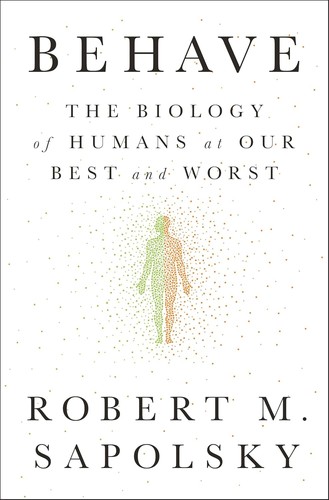
Behave
The title of this book caught my eye. Behave: The Biology of Humans at Our Best and Worst. Reflecting on it now, I think it is more than just a book on biology. I would say it bridges what we know about human biology and human psychology, with a hint of anthropology and philosophy mixed in there.
Just a tip for readers: Sapolsky can get very technical. He briefly explains technical terminology and concepts at the beginning of the book and in his appendices, but for someone like me who does not have a formal education in biology (I took one summer class in high school) or psychology (I like Malcolm Gladwell and that is about it), it can be a bit much. In fact, if you truly understood all of the technical concepts he presents, I think it is about the level of understanding that an undergraduate biology or psych degree would grant you. It is a lot, but don’t be scared. I found it helpful, when I did not understand something, to just keep reading. More understandable and applicable sections of the chapters always arose.
One part that I really loved about Behave was its chapter on genetics. In today’s day and age, people are very quick to pin genetics as the root cause of so many issues. But Sapolsky is very critical of this view. He speaks extensively about gene-environment interactions and epigenetics, and how genes are so coupled and interconnected that there are very few conditions that can be isolated to just one gene. One thing that stuck with me was how methyl tags attach to genes to switch them on or off, and how those tags can be triggered by the environment or by other genes (which themselves could be triggered by the environment or other genes). You can see why trying to isolate conditions to a single gene so often fails.
I also really loved his chapter on empathy. Sapolsky digs into why we feel empathy at all, why some people seem to have so much more of it than others, and whether it can actually be grown. One thing that surprised me was that when we watch someone get a needle pushed into their finger, the same part of our brain that processes our own pain (the anterior cingulate cortex) lights up. We feel a flicker of someone else’s pain because our brain is asking, “could that happen to me?” Sapolsky also points out that empathy is not evenly distributed. We naturally feel more empathy for people who look like us, sound like us, or belong to our “in-group,” and less for people we have been primed to see as outsiders. The part that hit me hardest was a brain imaging study he describes, where people were shown pictures of homeless people and drug addicts. The brain regions we normally use to think about another person as a person were barely activated. Their brains were responding to those people more like they were objects than humans. That is how empathy gets shut off in everyday life. Sometimes it looks like not even seeing someone as a person. That part was uncomfortable to read, because it forces you to admit your own empathy has blind spots, and probably some of those blind spots are people you walk past every day. But there is good news. Exposure to people different from you, perspective-taking, and even just imagining someone’s story in detail can expand it. This is one of the reasons I find meeting new people, reading, and traveling to be so valuable. Interestingly, empathy alone is not enough. Sapolsky makes the point that too much empathy can actually paralyze you. Real action requires empathy plus enough emotional distance to actually do something useful. That distinction stuck with me.
Towards the end, this book on biology and psychology becomes oddly philosophical. The author proposes that if so much of our behavior can be primed and predicted, how much of it is actually ours in the first place? One thing that stuck with me was when he wrote about women who were accused of witchcraft and killed in medieval Europe. What looked like demonic possession to the courts of the time, we now recognize as epileptic seizures. Sapolsky uses this to introduce the homunculus, the idea that there is a tiny person inside your brain who thinks, decides, and controls your actions. As we keep learning about how our brains and bodies actually function, the homunculus seems to be shrinking. In a sense, we use it to explain to ourselves the things we do not yet understand. What used to be witchcraft is now epilepsy. People who were cursed by demonic visions now have schizophrenia. What else will science explain away? Can people be blamed for their misdeeds? Can we really take credit for our greatest achievements? Do we have any free will at all? Those are the questions Sapolsky leaves you sitting with.
Behave is not a quick read, and Sapolsky will not hand you easy answers. What he will do is hand you a much bigger picture of what it means to be human. By the end, you start to see your own behavior, and the behavior of people around you, as the result of a long chain of biology, environment, and history that stretches back further than any single moment. That can feel unsettling at first, but I found it freeing. It made me a little slower to judge other people, a little more curious about what shaped them, and a little more honest about what has shaped me. If you are curious about biology, psychology, anthropology, philosophy, or just about people, I would highly recommend it. There is a lot of technical jargon, but don’t be afraid to skim it until you get to the real applications. The homunculus may be shrinking, but the questions it leaves behind are only getting bigger.