#15 Favorite
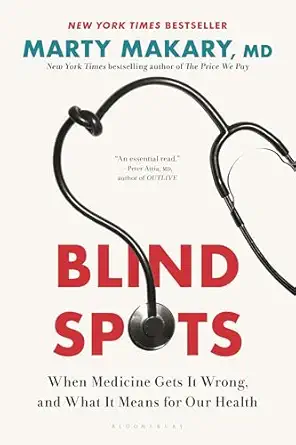
Blind Spots: When Medicine Gets It Wrong, and What It Means for Our Health
Reading Mukherjee’s The Gene and The Emperor of All Maladies left me with a question I could not shake. Both books trace how politics, ego, and institutional power shaped what got called science. I kept wondering how much of that was still happening today, dressed up in modern credentialing and peer review. This book is exactly that question answered.
Makary is a surgeon and public health researcher at Johns Hopkins. He is someone who has spent his career watching the medical establishment make confident, consequential mistakes and then resist admitting them. The book walks through a series of case studies, and the individual stories are alarming enough on their own. But the more I read, the more I noticed that the specific failures were not nearly as important as understanding what caused them.
The pattern is this: a surprisingly small group of people control what gets published in the most influential medical journals. Hyper-specialized physicians who built careers on a particular approach resist evidence that makes their life’s work irrelevant. Doctors carrying significant debt and professional obligations are reluctant to practice against the established standard of care, not because they think it is right but because the consequences of dissent are real. Medical schools and regulatory agencies accept funding and donations from the very industries they are supposed to be objectively evaluating. The result is a system that is structurally resistant to updating itself, even when the evidence demands it.
The examples Makary gives are specific and hard to dismiss. The American Academy of Pediatrics issued guidance in 2000 telling parents to keep children away from peanuts until age three, based on a misreading of a single study. Immunologists at the time already understood that early exposure builds tolerance, but the AAP did not consult them. Peanut allergies subsequently exploded. A 2015 clinical trial eventually showed that early peanut introduction reduced allergy risk by 86 percent, but by then an entire generation of American children had been affected.
As for Hormonal Replacement Therapy (HRT), a large 2002 study was misinterpreted to suggest that hormone replacement therapy caused breast cancer. Millions of women stopped treatment or were denied it. The study got shut down because it claimed HRT was causing breast cancer yet the results were not even statistically significant! Subsequent, better-designed studies showed HRT actually reduces the risk of heart attacks, bone fractures, cognitive decline, and colon cancer, and does not meaningfully raise breast cancer risk. Makary estimates that roughly 140,000 women died prematurely over two decades because of the resulting panic.
On antibiotics, the prevailing attitude for decades was that prescribing them carried no real downside. What that attitude missed was the devastation to the gut microbiome. Children given antibiotics in their first two years of life have significantly higher rates of obesity, ADHD, asthma, and celiac disease.
And on dietary cholesterol, the American Heart Association spent roughly six decades promoting low-fat diets without solid scientific support, which helped push Americans toward processed carbohydrates, and obesity rates followed.
None of these were fringe ideas being suppressed by a conspiracy. They were evidence-based corrections being slowed down by a system that rewards certainty, punishes dissent, and is not structured to apologize.
My advice coming out of this is to think critically and give yourself permission to ask questions. Having an MD does not mean someone holds all knowledge, and a confident recommendation is not the same as a well-evidenced one. This is not an argument for ignoring doctors. It is an argument for engaging with them. We now have tools that did not exist a generation ago. Intelligent models can pull together meta-analyses, flag methodological weaknesses in studies, and surface funding conflicts that would take hours to find manually. You can walk into an appointment informed, and you should.
Makary has his critics, and some of the pushback is fair. But the core observation is hard to argue with. The same dynamics Mukherjee documented in the history of cancer and genetics are not history. Those dynamics are ongoing, and this book makes it difficult to pretend otherwise.