#13 Favorite
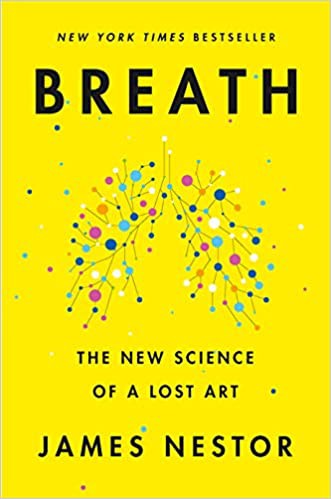
Breath: The New Science of a Lost Art
I found Breath by James Nestor at my parents’ house and picked it up out of pure curiosity. How can you write an entire book about breathing? Turns out there is a lot to say. Nestor is a journalist, not a doctor or scientist, which is both the book’s biggest strength and its biggest weakness. The strength is that the book reads like a story. He travels the world meeting researchers, doctors, and what he calls “pulmonauts” (his term for people who have spent their lives obsessing over breathing) and the writing has the pace of a good piece of investigative journalism. The weakness is that some claims are presented with more confidence than the underlying science actually warrants.
The most striking part of the book for me was the section on the Paris catacombs. Nestor went into the off-limits parts of the Paris quarries (which extend over 170 miles underneath the city, with the public catacombs being only about 5% of that) and looked at skulls from different eras. Older skulls had wide jaws, perfectly straight teeth, and large nasal openings. Skulls from the last few hundred years, after industrialization and the rise of soft processed food, had narrower jaws, crooked teeth, and smaller airways. The transition is shockingly clear when you see it laid out by time period. About 90% of modern humans have some crookedness in their teeth. The vast majority of ancient humans did not. It is one of those facts that I had never thought about before and could not stop thinking about after.
The reason for the change is chewing. Or really, the lack of it. Nestor argues that the modern soft, processed diet has stunted the development of our jaws and skulls. The maxilla (the main bone of the upper face) has stem cells that are activated by chewing, and those cells help the bone grow and reshape itself. When kids spend years gnawing through tough food, their jaws develop wide and their airways grow open. When kids spend years eating soft processed food, their jaws stay narrow, their teeth get crowded, and their airways stay tight. The downstream effects are real. Crooked teeth, impacted wisdom teeth, chronic sinus congestion, sleep apnea, and snoring all become more likely. About 40% of the modern population has chronic nasal obstruction. Mouth breathing is more common than people realize. Most of us have no idea why.
The book is also where I learned just how different nose breathing and mouth breathing actually are. I used to assume air was air. Turns out the nose filters out particulates, warms and humidifies the air before it hits your lungs, and produces nitric oxide, which helps your blood vessels relax and your lungs absorb oxygen more efficiently. Mouth breathing skips all of this. It dries out your airways, increases your risk of infection, and is associated with worse sleep, worse exercise performance, and even changes in facial structure over time. The case for nose breathing whenever possible (including during exercise) is much stronger than I expected before reading the book.
One of the weirdest claims in the book, and the one that took me longest to wrap my head around, is that CO2 matters at least as much as oxygen when it comes to actually getting oxygen to your tissues. The mechanism is something called the Bohr Effect, discovered in 1904 by a Danish physiologist named Christian Bohr (the father of physicist Niels Bohr, incidentally). The short version is that hemoglobin carries oxygen through your blood, but it will not release the oxygen to your tissues unless there is enough CO2 present. Higher CO2 means hemoglobin loosens its grip and your tissues actually get the oxygen. Lower CO2 means hemoglobin holds on tight and your tissues are basically being starved while your blood is technically full of oxygen. This is the opposite of what I always assumed. I always thought of CO2 as the waste product you wanted to get rid of as fast as possible. It turns out CO2 is the trigger that makes the whole oxygen delivery system work, and most modern humans are chronically over-breathing, which depletes CO2 and leaves their tissues quietly oxygen-starved. Nestor cites research suggesting that most modern people breathe about 18 to 20 times per minute, while the healthiest long-lived populations breathe more like 5 or 6 times per minute.
The Bohr Effect is also why nose breathing during exercise feels so impossible at first. When I started running with my mouth closed, it felt like I was suffocating, but my blood oxygen barely moved. The issue was that my body was not used to tolerating higher CO2. After a few weeks of training my nose breathing, what felt like suffocation started to feel normal, and what used to be normal breathing started to feel like over-breathing. Once you understand the Bohr Effect, the whole “breathe less, breathe slower, breathe through your nose” thing stops sounding like a wellness fad and starts sounding like basic physiology.
As a kid I had constant sinus congestion and infections. I was lucky to have an orthodontist who used a palate expander rather than just pulling teeth, which I now suspect is part of why I never needed my wisdom teeth removed. I cannot imagine how bad my breathing would be now if it were not for the expander Dr. Miller put in for me. Reading Nestor, I started incorporating his recommendations. I shifted to nose breathing almost all the time, even during exercise. I started chewing Falim gum, a Turkish gum he recommends because it stays tough instead of breaking down quickly. The sinus problems I had dealt with my entire life mostly went away. I cannot prove the gum is adding bone density to my skull, but I can say that the breathing changes alone made a meaningful difference in how I feel every day.
Nestor also covers a lot of other techniques. Box breathing for stress regulation. Tummo for cold tolerance. Mouth taping at night for people who cannot stop mouth breathing in their sleep. Slow, deep, deliberate breathing as a kind of nervous system reset. I have not fully integrated all of these into my life, but they all seem to have some real research behind them, and the book got me to take all of it more seriously than I would have otherwise.
One thing that frustrated me about this whole subject was the response I got from my own dentist. I asked her about chewing tougher foods and she told me to chew less because it wears down your teeth. She was not wrong about the wear, but it was a striking example of hyper-specialization missing the bigger picture. Yes, chewing wears down enamel. But it also shapes your airway, your breathing, your sleep, and probably your VO2 max, which is one of the metrics most strongly correlated with quality of life and longevity. I would rather have slightly more worn teeth and be able to breathe well than having perfectly preserved enamel with chronic sinus issues. It is wild to me that someone whose entire career involves studying the mouth never connected those dots.
My former roommate Josh is currently living in Ghana, and he recently texted me. He said that nobody where he is living gets their wisdom teeth removed because they all grow up chewing tough traditional foods. This tracks with what Nestor describes throughout the book. Populations that grew up on traditional diets that require real chewing tend to have wide jaws, straight teeth, wisdom teeth that come in normally, and dramatically lower rates of sleep apnea. The modern dental and orthodontic industry is largely treating the downstream consequences of a problem that could have been prevented through chewing tougher foods earlier in childhood. You sometimes wonder if orthodontists know exactly what causes crooked teeth and just have a quiet business interest in not telling anyone. But I think the truth is closer to the dentist I talked to. Each specialty is looking at its own narrow slice and nobody is looking at the big picture.
The book is not perfect. Nestor sometimes overstates his claims. One example that took me a while to wrap my head around is the weight-loss claim. He argues that the lungs are the weight-regulating system of the body, since fat loss happens almost entirely through exhalation (about 8.5 pounds of every 10 pounds of fat lost leaves the body as exhaled carbon dioxide, the rest as water). The biology behind that is real and has been published in the BMJ. From there he extends the argument to suggest mouth breathing causes weight loss through over-exhalation, which is the part that gets shakier. Yes, you exhale more CO2 when you mouth-breathe, but framing that as meaningful weight loss is a stretch since you are mostly losing CO2 that did not come from fat metabolism. The claim that adults can meaningfully reshape their skulls through gum chewing is also at the edge of the actual science and probably more true for kids than adults. If you read the book, do so with a healthy curiosity about what is well established and what is one journalist’s enthusiastic interpretation. The core of the book holds up though, which is that breathing matters more than most of us think, that nose breathing is significantly better than mouth breathing, and that chewing tough food early in life shapes a lot of what happens to your face and airway later.
If you have ever struggled with sinus issues, sleep problems, or anxiety, this book is worth your time. The recommendations are mostly free and low risk. Best case is that a chronic issue you have lived with your whole life turns out to have been a breathing problem all along. It is one of the few books I have read where the recommendations actually changed how I feel every single day.