#14 Favorite
Data-Driven Science and Engineering: Machine Learning, Dynamical Systems, and Control
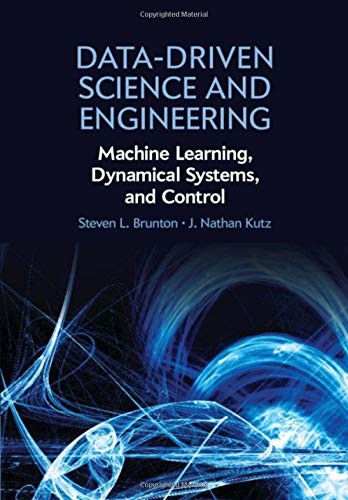
Steve Brunton is the man. His YouTube channel got me genuinely excited about controls and applied math and is a big reason I went to graduate school for it. Data-Driven Science and Engineering: Machine Learning, Dynamical Systems, and Control is the textbook he wrote with Nathan Kutz, and the best part is that the full PDF is free and legal at https://databookuw.com/databookV2.pdf. The authors also put up companion video lectures for almost every chapter, and most chapters have their own dedicated playlist on YouTube. If you want to seriously learn this material, the combination of the book plus the lectures is probably the best free resource out there.
The chapters that stuck with me most were the ones on the singular value decomposition (SVD), Fourier analysis, and compressed sensing. The video lectures on these topics were even better than the book chapters. It is honestly wild how much these foundational math concepts show up everywhere in modern controls and AI. Reinforcement learning, classical control, physics informed machine learning, data driven control, and almost everything else in the field involves these ideas in some shape or form. Once you actually understand SVD and Fourier analysis, a huge amount of what looks like dark magic in machine learning starts to feel familiar.
The underlying theme of the book, and really of all of Brunton’s work, is something I keep coming back to. There is this misconception in engineering that things have to be big and complicated to work well. Brunton argues the opposite. The goal is to make things as simple as possible but no simpler, to extract the signal out of the noise, and to use sparsity to your advantage. The most powerful models are not the ones with the most parameters. They are the ones that capture the underlying structure of the problem in the fewest possible terms. That philosophy runs through the entire book, from the SVD chapter all the way to his sparse identification of nonlinear dynamics (SINDy). I love it all.
A few honest drawbacks. This is not a book you can pick up and read cover to cover without supplemental material. The math is technical, and if you do not have a solid background in linear algebra, differential equations, and multivariable calculus, you are going to struggle. Learn those first and come back to this. The companion videos help a lot, and the papers that Brunton and Kutz publish (which they also make free and public) often go into more depth than the chapters do and are surprisingly readable for academic literature. In my opinion, Kutz’s chapters were harder to follow than Brunton’s. That might just be a matter of teaching style and what clicks for me. I read the book before LLMs were good enough to be useful for explaining these kinds of concepts, but if I were doing it today I would absolutely paste sections into ChatGPT and ask it to explain anything I got stuck on.
If you are an engineer, a scientist, or anyone working in controls or applied machine learning, this book belongs on your shelf or your computer. It is one of the rare resources that takes you from foundational math all the way to the research frontier in a single coherent voice. Pair it with the YouTube lectures and you basically have a free graduate level course (or degree). The world needs more content creators like Brunton and Kutz, and the fact that they made all of this available for free is a real gift to anyone trying to learn.