#18 Favorite
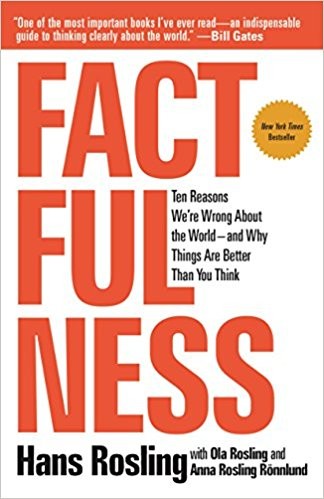
Factfulness: Ten Reasons We're Wrong About the World—and Why Things Are Better Than You Think
I found this one through a ChatGPT recommendation and picked it up from the public library. Factfulness is one of the more educational books I have read, and also light enough to read before bed. Rosling wrote it to be accessible, and it shows.
The central argument is simple: when asked basic questions about global trends, people are not just wrong. They are systematically, predictably wrong in ways that make the world look far worse than it actually is.
Questions like: what share of the world’s population lives in extreme poverty? Is child mortality going up or down? How many girls in low-income countries finish primary school? Most people guess dramatically wrong, and not randomly. Rosling tested this across countries and found that most people, including doctors, journalists, and Nobel laureates, scored worse than chimpanzees randomly picking answers. The chimps were just guessing. The humans were guessing too, but in one consistent direction: toward catastrophe.
Most of that bias comes from the media. The media is not designed to give you an accurate picture of the world. It is designed to keep your attention, and fear keeps attention better than progress does. A million children not dying because of expanded vaccination coverage is not a story. So we walk around with a mental model of the world that is decades out of date, shaped almost entirely by what goes wrong rather than what quietly gets better. Extreme poverty declining. Child mortality falling. Life expectancy rising. Literacy rates up. Female education expanding. Hunger down. Deaths from war and natural disasters lower than they have ever been in recorded history. None of this makes the front page, yet all of it is real.
Rosling breaks humanity into four income levels, as he deems income to be a great proxy for quality of life. Each income level is roughly four times the income of the one below it. At Level 1, a dollar a day, you walk barefoot and cook over an open fire. At Level 4, sixty-four dollars a day or more, you fly on airplanes and complain about the wifi. Most of the world is not at Level 1 or Level 4, but rather lies somewhere in between, moving upward. And the jump between each level matters enormously for quality of life, even though the income differences can look small in absolute terms. That logarithmic relationship between money and wellbeing was one of the more eye-opening things in the book for me.
I know a lot of people who frequently travel yet almost never leave the United States. I wish they would read this. The US is a big country but it is also a remarkably uniform one. You can drive coast to coast and never really leave the same culture, the same infrastructure, the same frame of reference. Traveling somewhere genuinely different forces a reassessment of the world that domestic travel rarely does. The fear of Latin America, Southeast Asia, or sub-Saharan Africa that keeps people from going is almost entirely a product of the media’s highlight reel. Those places are not what the news makes them out to be, and the data Rosling lays out makes that point.
The personal stories in the book are what stuck with me the most. Rosling spent years doing fieldwork in Mozambique studying a paralytic disease called Konzo. On one visit, while taking blood samples in a village, the crowd turned. Someone started shouting that Rosling was stealing their blood to sell it. Machetes came out, and there was nowhere to run. A barefoot woman around 50 years old stepped out of the crowd, faced the shouters, and talked them down. That woman was all that stood between Rosling and a very bad ending. The story is extreme, but the mechanism behind it is not. When people lack accurate information, fear fills the gap and the narrative it creates can be very wrong, and sometimes very dangerous. That is true in a village in Mozambique and it is true everywhere else too, including in how most of us picture the world beyond our borders.
What makes this book most powerful is knowing that Rosling wrote it while dying of pancreatic cancer. He died in February 2017. His son Ola and daughter-in-law Anna finished it and saw it published in April 2018. His last words in the manuscript were a plea for a fact-based worldview, not because the world is perfect, but because you cannot fix what you do not accurately see. The fact that he spent his last months on this book rather than anything else says something incredibly meaningful.
There are fair criticisms of Rosling’s worldview. He has been accused of cherry-picking the statistics that trend upward while ignoring the ones that do not, and there is something to that. The book does not spend much time on plastic in the oceans, biodiversity loss, or the ways economic growth has come with ecological costs that are not fully priced in. Rosling was not naive, but he was selective, and readers who come away thinking everything is fine have missed his actual point. He called himself a possibilist, not an optimist. While the progress we make is not guaranteed or evenly distributed, it is real.
This is still one of the more impactful books I have read that genuinely changes how you see the world. I’d encourage you to read it and go somewhere wildly different from everything you know.