#20 Favorite
Fluent Forever: How to Learn Any Language Fast and Never Forget It
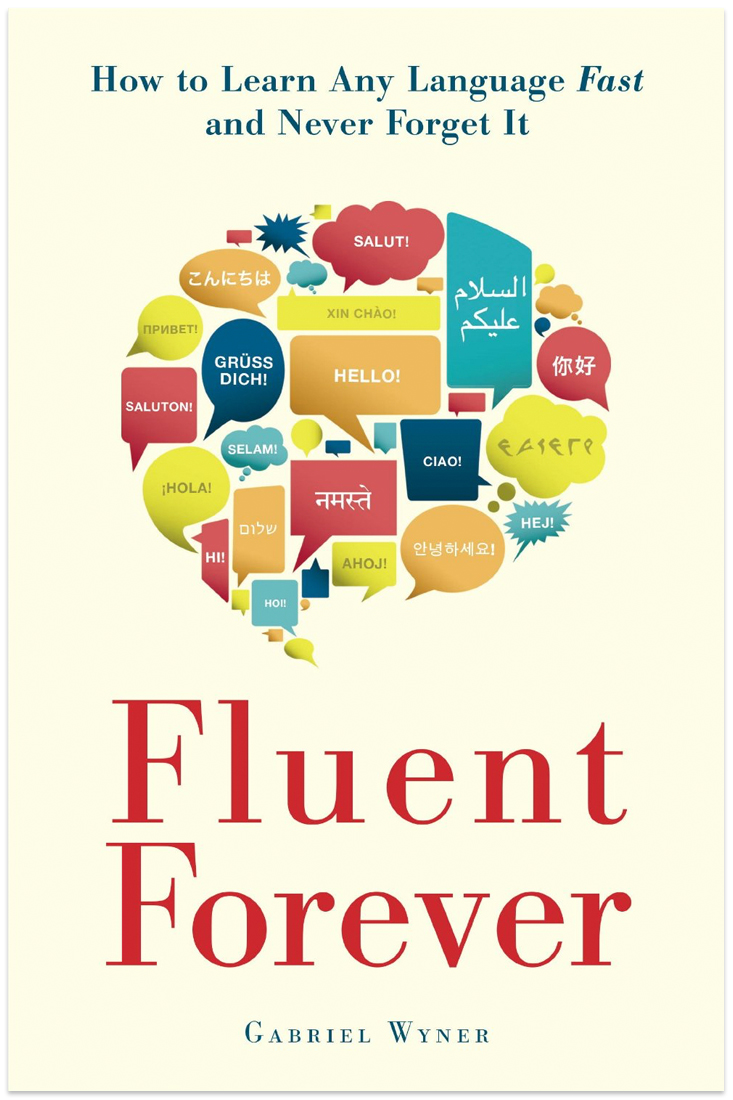
My mom gifted me Fluent Forever by Gabriel Wyner because she knows I love learning foreign languages. Wyner is an interesting author for a language book. He was an opera singer before he was a polyglot, and the book grew out of his real problem of needing to sing in languages he did not actually speak. He now claims fluency in seven languages, all self-taught using the system he describes in this book. The methods are built around three core ideas: learn pronunciation before vocabulary, never translate (think in images instead), and use spaced repetition systems like Anki to make new vocabulary stick. Each of these is backed by real cognitive science and each one runs counter to how most people are taught languages in school.
The single most useful idea in the book is spaced repetition. The basic concept is that your brain remembers things most efficiently when you review them right before you would otherwise forget them. The forgetting curve is steepest right after you first learn something, so the first review needs to come soon after initial exposure. For later reviews, the intervals can stretch out exponentially. Anki, the flashcard app Wyner recommends, automates this. You rate how well you remembered each card, and the algorithm figures out when to show it to you again. Spaced repetition is also strongly backed by sleep research. Sleep is when new memories get consolidated. So when you study flashcards across multiple days instead of cramming the night before, your brain has a better chance to file new words into long term memory.
Another idea I loved is Wyner’s argument for visual memory over verbal memory. Our brains are dramatically better at remembering images than at remembering abstract words or definitions. So instead of learning “perro means dog” as a translation, you should learn “perro” attached to a vivid image of a specific dog. The word stops being a label for an English word and becomes its own thing in your head, tied to a memory you can actually picture. This idea pairs really well with what I read in Moonwalking with Einstein, where the world’s top memory champions use elaborate memory palaces full of vivid mental images to memorize huge amounts of information. The underlying mechanism is the same: our visual memory is the strongest memory system we have, and language learners who do not use it are leaving most of their cognitive horsepower on the table.
Wyner makes a big deal about learning pronunciation first, before any vocabulary. He does this by mastering the phonetic alphabet of the target language. His argument is that if you do not learn to actually hear the sounds correctly, you end up creating what he calls word doubles in your head. You pronounce the word in your head one way and hear native speakers pronounce it a different way. Your brain then has to do extra work to connect the two as the same word. By learning the International Phonetic Alphabet (IPA) for the language first, you train your ears to actually distinguish the sounds of that language. His background as an opera singer informs this strongly. Singers have to pronounce languages perfectly before they have time to learn them, so they have spent centuries developing techniques to nail pronunciation fast. Wyner just applies the opera singer’s approach to language learners.
One of my favorite ideas in the book is using the concept behind the game Taboo as a language learning strategy. The idea is to describe a word you do not know in a foreign language to a partner using only the limited vocabulary you already have in that language. You do this until they recognize what word you are referring to. It forces you to think in the target language, work around gaps in your vocabulary, and use the words you do know more flexibly. I have done this in conversation, and it is brutal and effective. You remember every word you had to fight to describe, because the act of fighting to describe it embeds it deeper than passive memorization ever could.
Wyner also makes the case that embarrassment is part of the learning process. The faster you make mistakes, the faster you learn. I have found this is genuinely true. The times I have improved fastest in a foreign language are the times I forced myself into situations where I had no choice but to speak it. The discomfort is the lesson. The brain remembers what we were uncomfortable with because that is exactly how it is wired to learn.
This connects to one of the more counterintuitive claims in the book, which is that adults actually learn languages faster than kids. The conventional wisdom is the opposite, that kids are linguistic sponges and adults have lost the magic. But Wyner argues, and the research backs him up, that adults are actually faster in the beginning stages of language learning. The reasons kids end up at higher levels of fluency are not really about brain plasticity. They are about exposure (kids are immersed all day, every day) and shame (kids are not embarrassed to make mistakes constantly, so they get way more reps). The “critical period” for language acquisition is real, but it does not start to close until around age 17 or 18, much later than people usually think. So if you are an adult thinking it is too late to learn a new language, you are wrong. You just need to commit to enough exposure and be willing to embarrass yourself the way a kid does.
I am a frequent user of Duolingo, and I will admit it is probably not the most efficient way to learn a language. The spaced repetition is weaker than Anki’s, and the gamification can make you feel like you are learning more than you actually are. But here is what I will say in its defense. Consistency is the single most important factor in language learning, and Duolingo has made me consistent for years. It is free, it is on my phone, and the streak mechanic actually works on me. Maybe the optimal stack is Anki for vocabulary, IPA training for pronunciation, conversation practice for fluency, and Duolingo for daily reps.
Also, on the topic of better tools, I genuinely wish there was a VR version of Duolingo (or any language learning app). Being able to walk into a virtual market in Madrid and actually order tapas in Spanish would be a game changer for the people, like me, who do not have time to spend months abroad.
If you are serious about learning a foreign language, read this book. It will not do the work of learning for you, but it will give you a framework for spending your time on the right things instead of the popular things. Most people give up on languages because they convince themselves it is too difficult or too late. Wyner makes a strong case that it is not.