#2 Favorite
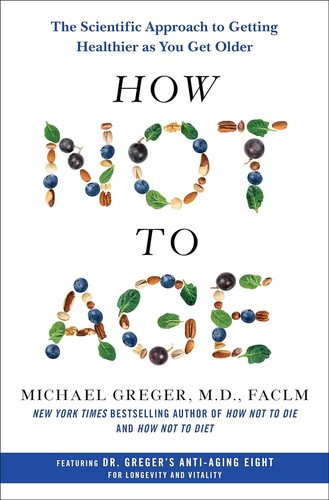
How Not to Age: The Scientific Diet to Live Longer and Healthier
I came across How Not to Age by Dr. Michael Greger at the public library while browsing the large-print nonfiction shelf. I love large-print books because they make me feel like I read faster than I actually do. The title caught my eye, and figuring that the sooner I learned this stuff the better, I picked it up. Greger is a physician and the founder of NutritionFacts.org, where he reviews nutrition research weekly. He is also famously thorough about his sources, which is probably the single best thing I can say about him as a writer.
This book genuinely changed how I eat and view nutrition. What I love about Greger is that he cites everything, calls out studies with poor methodology, and is quick to flag conflicts of interest in funding sources. He leans heavily on meta-analyses to figure out where the actual scientific consensus lands on diet, which turns out to be a lot more settled than most popular nutrition writing would have you believe. He is also blunt about which studies are junk. A lot of nutrition writing is built on a single paper that got picked up by a magazine. Greger is willing to spend pages walking through why a study you have probably heard about is actually not very good evidence, and that kind of rigor is rare in this space.
One of the things the book made me realize is just how little doctors learn about nutrition. A widely cited study found that US medical schools provide an average of just 19 hours of nutrition education across four years of training, which is less than 1 percent of total instruction time, and most schools do not even meet the National Academy of Sciences recommendation of 25 hours. So when your doctor shrugs at a diet question, it is not usually because they do not care. It is because they were never really taught. More and more medical schools also seem to want to carve the body into pieces and assign a specialist to each one. Few doctors I have encountered have much appreciation for how interconnected the body really is, and one of the pillars of holistic health that Greger drives home is that the food you eat ends up impacting every system in your body downstream.
Greger can sound like a broken record, and his bias toward a whole foods plant-based diet is obvious throughout. But he makes the case well, especially when he points to the populations that actually live the longest. The Blue Zones, the five regions in the world with the highest concentration of people who live to 100, all eat predominantly whole, plant-based diets. Okinawa Japan, Sardinia Italy, Nicoya Costa Rica, Ikaria Greece, and the largely vegetarian Seventh day Adventists of Loma Linda California all follow these dietary patterns. None of these populations ate the modern American diet. None of them loaded up on processed meat, refined sugar, or industrial seed oils. They ate mostly plants, mostly whole, mostly local, and they lived a lot longer than the rest of us. That is the kind of evidence that is hard to argue with.
Where I am less convinced is on the specifics of what makes the modern diet so bad. Greger is hard on meat, but I am not sure the problem is meat itself versus the processing most Americans pair it with. A piece of grass fed steak is not the same thing as a hot dog made of mechanically separated trimmings packed with nitrates and sodium. Same with saturated fat. I am skeptical that it is quite the villain he makes it out to be. Could the strong correlation between animal products, saturated fat, and bad health outcomes be a processing story rather than a food story? Is the issue what we eat, or what was done to it before we ate it? I am still working that out, and I do not think Greger fully resolves it either.
Greger also opened my eyes to how corrupt the regulatory and research landscape is in the United States. The supplement industry has been largely deregulated since the Dietary Supplement Health and Education Act of 1994, which exempted supplements from FDA pre-market approval. That means a company can put almost anything on a shelf and call it a supplement without proving it works or even that the bottle contains what the label claims. I no longer buy supplements unless they are USP certified, which is the gold standard third party verification that the product actually contains what it says it contains. The gap between privately funded studies and meta-analyses of publicly funded research is also genuinely shocking. The conclusions often point in opposite directions, and you can usually predict which direction a study will go just by knowing who paid for it.
A few honest caveats. Greger repeats himself, so one of his books is probably enough. And while diet matters enormously, the book gives sleep and exercise short shrift. Both of those are comparable in importance to diet for healthy aging, and a more complete book would have given them more room. If you want a deeper take on sleep, read Why We Sleep by Matthew Walker. If you want exercise, Outlive by Peter Attia spends a lot of time on the muscle and cardiorespiratory side. How Not to Age is one piece of a bigger puzzle, not the whole picture.
But if you want to know what to eat to feel good and live a long time, this is a great read. It changed how I think about food, how I think about meta-analyses, and how I think about which “experts” I should actually trust. The most useful thing the book does is teach you to read nutrition claims with the same skepticism you would bring to any other industry that has billions of dollars riding on what you believe. That skill is worth more than any single recommendation in the book.