#5 Favorite
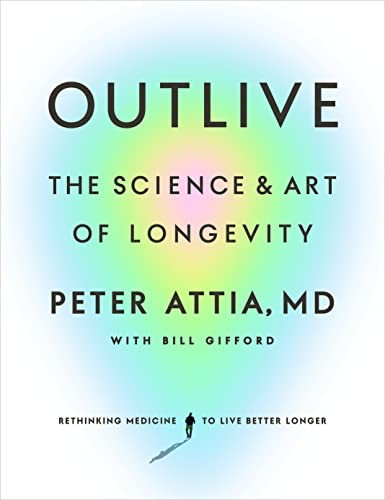
Outlive: The Science and Art of Longevity
My parents were gifted this book. I found it on their shelf and read the whole thing. I have been begging them to read Outlive ever since.
Attia trained as a surgeon at Johns Hopkins, left practicing medicine out of frustration with a system he felt was not actually serving patients, and redirected his career toward something more interesting to him: preventing people from getting sick in the first place. He calls this Medicine 3.0, and the basic premise is that the entire orientation of modern medicine is backwards. We wait for people to get sick, then we try to treat them. Attia thinks that by the time you are getting treated, you have already lost years you did not have to lose.
His argument for why this matters now is one of the more clarifying things I have read. When you strip out deaths from infectious diseases, which antibiotics and vaccines largely addressed by the mid-twentieth century, human progress against the remaining causes of death has been surprisingly flat. The diseases killing most people today, what Attia calls the Four Horsemen: heart disease, cancer, neurodegenerative disease, and metabolic dysfunction, have not yet been solved. They can be managed, but sadly it is usually too late. The part that most stuck with me: the diagnosis you receive at 60 is not a sudden event. It is the output of decades of accumulated neglect. The heart attack, the tumor, the cognitive decline, those are the ends of very long stories. Attia wants you to start revising the story now.
The distinction he draws between lifespan and healthspan is one of the more useful frameworks in the book. Living to 100 is not interesting if your last 20 years are spent in serious physical and cognitive decline. He spends a lot of time focusing on muscle mass, fall prevention, and grip strength. The fall prevention piece sounds mundane until he walks you through what actually happens after a serious fall in old age. You recover, but during recovery you lose muscle. Lost muscle makes the next fall more likely and the recovery slower. The positive feedback loop is brutal, and it often ends tragically. The grip strength piece surprised me even more. There is a meaningful correlation between grip strength and dementia risk, and Attia treats grip strength as a useful proxy for overall muscular force production. My own read on why: dementia is a metabolic condition, and people with more muscle mass are better at clearing glucose from the blood, which could explain why we see less cognitive decline in people who maintain muscle as they age. While this is just my theory, the underlying data on grip strength is real, and it fits a broader pattern in the book: the things that keep your body working well tend to keep your brain working well too. He is not trying to keep you alive forever, but he is trying to make sure that at 75 you can still do the things that make being alive worthwhile.
This book is also a big reason why exercise became non-negotiable for me after I started working full time. In college, exercise just kinda happens. You play sports with friends, you walk everywhere, your body moves without you having to schedule it. Once you have a full time job, you have to make exercise a priority. The research Attia draws on suggests that roughly 20 minutes of daily exercise translates to about an hour of additional life. That math eventually gets hard to ignore. But I think people resist it because they picture the wrong thing. The common assumption is that longevity just pads the end of your life, the part most people are least excited about anyway. That is not really how it works. When you slow aging pathways down, the benefit gets distributed across your whole life. You are not buying more years at 90. You are feeling better at 40, sharper at 55, and more capable at 70. The time does not pile up at the end, but rather it spreads out.
Where I push back on the book is on nutrition. Attia recommends roughly one gram of protein per pound of body weight per day, which is more than double the standard dietary guidance. His reasoning is not unreasonable: the recommended daily amount was set to prevent deficiency, not to optimize muscle preservation as you age, and there is decent evidence that higher intake matters more as you get older and your body becomes less efficient at using protein. I agree with him that older adults should prioritize and even supplement easily synthesized protein sources to build and maintain muscle mass. But he leans heavily on animal protein for everyone, not just older adults, primarily because of bioavailability, and he largely sidesteps the evidence that animal proteins tend to accelerate aging pathways like mTOR. This is the same mechanism he discusses in the context of rapamycin, a drug that works precisely by dialing mTOR down. You cannot simultaneously make the case for rapamycin as a longevity intervention because it suppresses mTOR and also wave away dietary choices that drive mTOR up. The Mediterranean diet void of processed foods, has some of the most robust long-term outcome data we have, and sadly it gets less attention than it deserves. Attia is right that dietary science is genuinely hard to do cleanly, but I think the gap he leaves there is meaningful.
Then there is the Epstein situation, which I cannot fully set aside (why you got to do this to us Peter 😭😭😭😭😭). Earlier this year the DOJ released millions of documents, and Attia’s name appeared over a thousand times in the correspondence. He has denied any involvement in criminal activity and maintains his interactions with Epstein were professional. Some of the emails that surfaced were, by his own admission, embarrassing and indefensible. He resigned from a CBS News contributor role shortly after. He has not been charged with anything. I do not think it invalidates the science, but it is worth knowing.
The book is a great read. The core ideas are sound, the argument for taking your health seriously in your 20s and 30s is one of the better ones I have come across, and Attia is honest about what we do not yet know. The best cure for most of these diseases is still prevention, and this book makes that case better than anything else I have read on the subject. He also spends a lot of time on rapamycin, the only drug currently proven to extend lifespan in mammals. He makes a credible case that it warrants serious human trials. Unfortunately, nobody is funding those trials because rapamycin is off-patent and there is no profit in it. But if I ever had the money, you better believe that’s the check I would write.