#11 Favorite
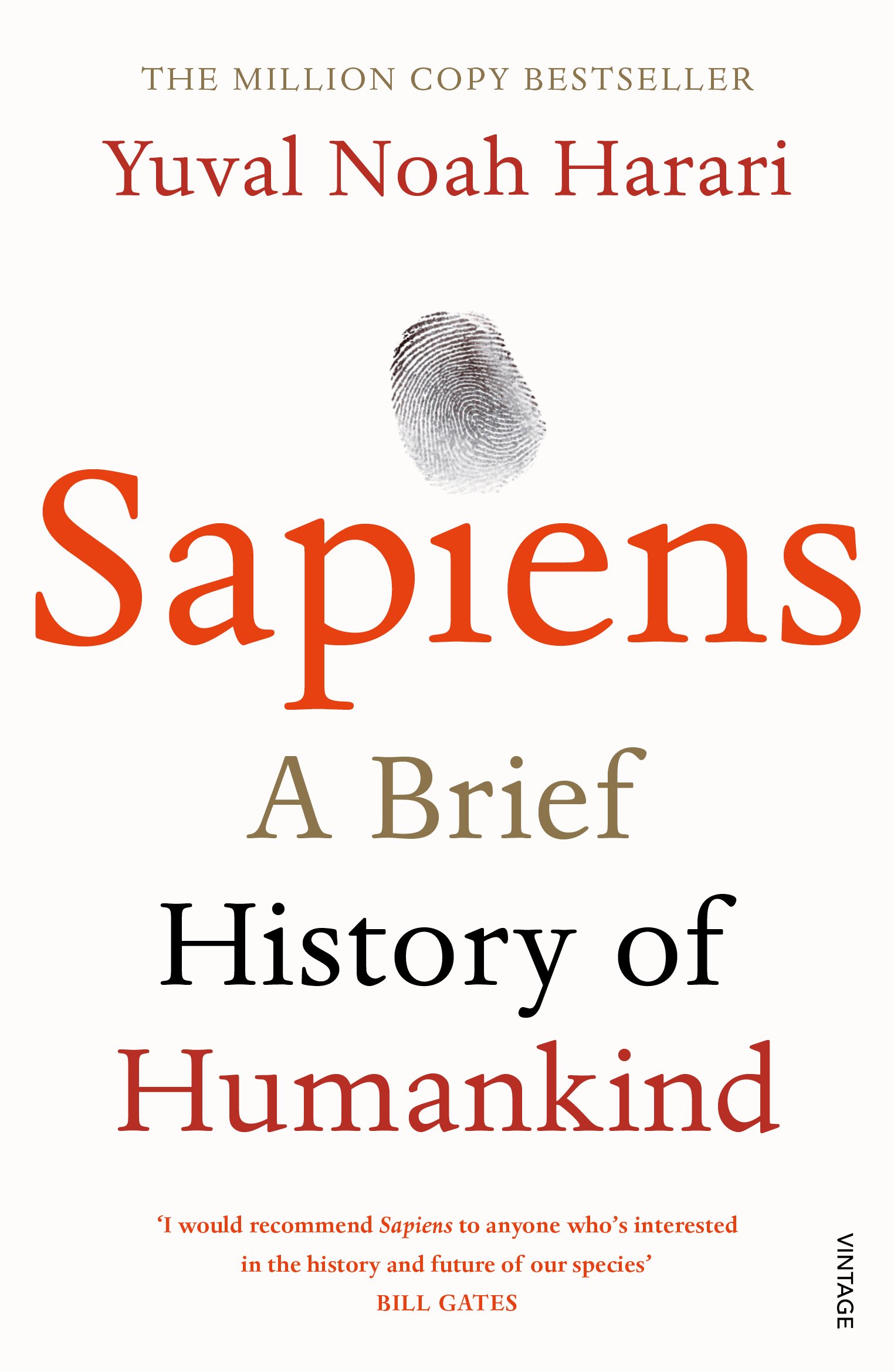
Sapiens: A Brief History of Humankind
I was assigned to read one chapter of Sapiens by Yuval Noah Harari for my macroeconomics class in college. I cracked it open expecting a dry econ textbook excerpt, got hooked within a few pages, and ended up reading the whole book. Harari is a history professor at the Hebrew University of Jerusalem and the book is based on his undergraduate world history lectures. The whole thing is structured around three revolutions that he argues shaped everything about who we are today: the Cognitive Revolution about 70,000 years ago, the Agricultural Revolution about 12,000 years ago, and the Scientific Revolution about 500 years ago.
The central thesis of the book is that humans dominate the planet because we are the only species that can believe in things that exist only in our collective imagination. Money is paper or a number in a database, but it works because millions of strangers all agree to act like it has value. Nations are lines on a map, but they hold together because enough people believe in them. Corporations, religions, human rights, laws, even the idea of a brand. These are all “shared fictions” or what Harari calls imagined orders. The cognitive leap that made all of this possible happened about 70,000 years ago when humans developed language not just to describe what was in front of them, but to talk about things that did not physically exist. No other species can do this. A chimpanzee can scream that there is a lion in the bush, but it cannot rally a thousand chimpanzees to fight a war over an imaginary line on a map. That ability to coordinate at scale around shared fictions is the entire reason humans are at the top of the food chain instead of somewhere in the middle, where we used to be.
One thing that stuck with me is that we still do not really know why humans have such big brains. Our brains burn through about 20 percent of our energy at rest while only making up 2 or 3 percent of our body weight. That is an enormous evolutionary cost. The weird part is that the big brain showed up hundreds of thousands of years before we started doing the things it eventually let us do, like building tools at scale, agriculture, language for abstractions, all of it. So for most of human history, our giant expensive brains were not really paying off in proportion to what they cost. Why evolution paid that price up front before we needed it is genuinely still unanswered.
The most provocative chapter, and probably the one that stuck with me the most, is the one about the Agricultural Revolution. Harari calls it “history’s biggest fraud.” The conventional story we learn in school is that agriculture was a leap forward, the moment humans rose above mere survival. Harari argues the opposite. For most of human history, we were hunter gatherers, and that life was actually pretty good. The earth provided what people needed and you could move when conditions changed. The diet was wildly diverse, with dozens of foraged plants and animals. Work was hard but only a few hours a day, with plenty of time for socializing and rest. When humans started farming, they got an initial food surplus, populations exploded as a result, and then they were trapped. The earth could no longer support that many people through foraging alone. So farming was no longer optional; it was the only thing keeping the larger population alive. And farming life was worse on almost every dimension. Diet narrowed to a few staple crops. Work hours got longer, and the labor was backbreaking. New diseases jumped from livestock to humans. Social hierarchies emerged because surplus meant some people could hoard while others starved. Life expectancy actually dropped. Harari’s line is that wheat did not just feed us, wheat domesticated us. We did not improve our lives. We just locked ourselves into a system we could no longer leave.
You see this pattern play out again and again in modern life. Email and Slack are probably the cleanest current example. They make our lives objectively worse in a lot of ways: constant interruptions, more work per day, the expectation of always being reachable. But there is no going back. The world has restructured itself around these tools, and any individual person who tries to opt out gets left behind. The trap is not that the technology is bad. The trap is that once enough people adopt it, opting out becomes its own kind of cost. Once the population scales up around the new system, the old way of life is no longer available, even if it was better.
The one idea that stuck with me about the Scientific Revolution Section is Harari’s argument that what made science different from previous knowledge systems was a willingness to admit ignorance. Most pre-modern societies operated under the assumption that all important truths had already been revealed, either in scripture or through ancient wisdom. Science flipped that. The willingness to say “we do not know yet, but we can find out” was the cognitive shift that powered the last 500 years. That is a deceptively simple idea but I think about it a lot, especially when I see modern movements that talk like they already have all the answers.
One criticism of Sapiens is that it simplifies a lot of human history and tends to lean heavily on a Western or Eurasian view of it. The book is trying to tell one big story about all of humanity, but in practice a lot of the evidence and examples come from places like Europe and the Middle East, mainly because that is where the best records exist. That means other regions and histories can end up feeling underrepresented or flattened into the same pattern, even though real human development was much more varied and uneven across different parts of the world. Because of that, some historians and anthropologists argue that the “three revolutions” framework can make history look cleaner and more unified than it actually was. There is also debate around some of the claims about hunter-gatherer life, like whether it was generally better or more equal than early farming societies, since the evidence for that is limited and not consistent everywhere. Still, that simplification is part of why the book works. It is not trying to be a detailed academic history. It is trying to give a big, understandable framework for thinking about human development, even if that comes at the cost of nuance.
Despite the criticisms, I would still recommend this book. It is one of those rare books that gives you a framework for thinking about why the world looks the way it does, and even five years after reading it I find myself coming back to its ideas regularly. The cognitive shift from “we are just smart apes” to “we are apes who learned to coordinate around shared imaginary stories” is the kind of reframe that changes how you look at every institution you interact with.