#12 Favorite
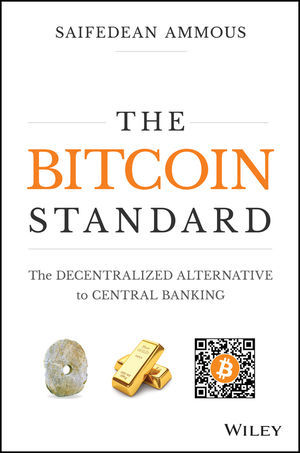
The Bitcoin Standard: The Decentralized Alternative to Central Banking
I picked up The Bitcoin Standard by Saifedean Ammous thinking it would be a technical book about how Bitcoin actually works. The protocols, the mining, the consensus mechanisms, the cryptography. It turns out the book is barely about any of that. It is primarily an economic and historical argument about why Bitcoin matters, framed through the lens of monetary history. Once I got over the surprise, I actually loved the book. If you want to understand the philosophical case for Bitcoin, this is the book to read. If you want to understand how Bitcoin works under the hood, you need to look elsewhere.
The most valuable thing this book did for me was teach me the history of fiat currency. The US dollar started out as basically a bank receipt for gold. You could walk into a bank, hand over a piece of paper, and walk out with the gold it represented. People treated those receipts like gold itself because they were easier to carry and easier to trade. The problem was that there was no single bank receipt that was widely accepted. Thousands of state-chartered banks each printed their own receipts, and a $5 note from a bank in Connecticut might be accepted at full value in Connecticut but at a discount or not at all in Maryland. If you traveled across state lines, you had to convert your notes at a loss. Worse, if a bank got into trouble and could not back its receipts with actual gold, customers would rush to redeem all at once, and the bank would collapse.
Bank runs were a regular feature of American economic life in the 1800s. The chaos created real demand for a uniform currency, and that demand is what eventually pulled the federal government into the money business. The National Banking Act of 1863 was the first big move toward centralization, partly to fund the Civil War and partly to fix the patchwork mess of competing private notes. Over the following decades, the government progressively consolidated control over the money supply, and that consolidation set the stage for everything that came after. Each step in the process had a real practical justification, but it also moved the country further from the original “the dollar is a receipt for gold” model and closer to “the dollar is whatever the government says it is.”
To understand why all this matters, Ammous spends a lot of time on what actually makes something good money in the first place. His criteria are pretty simple. Good money cannot be easily inflated, because if anyone can produce more of it on demand, the value of what you already hold gets diluted. It needs to be easily divisible so you can use it for a sandwich or a house. It needs to be durable, so it does not rot or rust or spoil. And it needs to be portable so you can actually use it in trade. Gold, especially once it was minted into standard coins, hit almost all of these criteria. It is scarce, it is divisible, it does not corrode, and you can move it around. The funny thing is that gold does not have many practical uses outside of being money and jewelry. That is actually a feature, not a bug, because it means people who own gold are not competing with industrial demand the way they would with copper or oil. Once you understand this framework, every form of money in the book gets evaluated against the same checklist, and most of them fail in obvious ways.
The first big crack in the gold standard came during World War I. The new Federal Reserve System (created in 1913) printed money to finance the war and to support Liberty Bond sales at a pace that far outstripped the amount of gold backing it. The US technically stayed on the gold standard but Wilson banned gold exports in 1917, which suspended the international part of the system. The dollar held its official value, but in practice the connection between dollars and gold was already getting strained. After the war, the US restored full convertibility in 1919 and the broader world stitched together a watered-down version called the Gold Exchange Standard from 1925 to 1931. By that point, gold was still in the system, but each restoration was a little weaker than the version before it.
The next big chapter in the story is the Depression of 1920-1921, when the US had just restored gold convertibility. It is surprising that most people have never even heard of the Depression of 1920-1921 given just how severe it was. Unemployment hit nearly 12 percent and industrial production fell about 25 percent, which is comparable to the early years of the Great Depression. Despite how serious the Depression of 1920-1921 was, it ended in about 18 months. The Wilson and Harding administrations cut government spending roughly in half and the Federal Reserve raised rates instead of cutting them. The economy was allowed to clear out the malinvestments from World War I and recover on its own. Compare that to the Great Depression a decade later, where the response was massive government intervention, and the slump dragged on for over a decade until World War II. The Austrian school of economics, which Ammous belongs to, argues that recessions are necessary corrections of prior credit-fueled booms, and that intervention only makes them longer and worse.
One of the wildest stories the book describes happened during the Great Depression itself. FDR signed Executive Order 6102 in 1933, requiring American citizens to hand over their gold to the federal government at $20.67 per troy ounce. Refusing to comply could land you a $10,000 fine or ten years in prison. Once the government had collected most of the gold, it revalued gold from $20.67 to $35 per ounce, which was about a 70 percent jump. So citizens were forced to sell low and then watched the government immediately mark it up. Americans did not have the legal right to own gold again until 1974 under President Ford. It is a 41 year stretch where the basic right to own a piece of metal was illegal, and most people have never even heard this. Once you know this story, “decentralized money the government cannot seize” stops sounding like a libertarian fantasy and starts sounding like a reasonable response to real history.
The final step in the breakup with gold came after World War II. The Bretton Woods system, established in 1944, pegged other countries’ currencies to the US dollar, and the US dollar to gold at $35 per ounce. Foreign governments could exchange their dollars for US gold. But by the 1960s, the US was printing way more dollars than it had gold to back, mostly to finance the Vietnam War and Lyndon Johnson’s social programs. By 1971, foreign governments started catching on and demanding their gold back. France famously sent a literal warship to New York harbor to take its gold home. So in August 1971, Nixon unilaterally ended dollar to gold convertibility, breaking the promise that had been the foundation of the global monetary system. Since then, the entire world has run on fiat currency, which is to say currency backed by nothing except trust in the government that issues it. The book makes a strong case that this transition was not some natural evolution but a series of broken promises by governments that wanted to print more money than they could honestly back.
Once you understand this history, the rise of a giant unaccountable financial sector starts to make a lot more sense. When governments can print money to bail out the financial sector whenever it screws up, the incentive structure becomes obvious. If the economy is doing well, the bankers win and keep their bonuses. If things go wrong, the losses get socialized through inflation and FDIC insurance, which the rest of us pay for through reduced purchasing power. Why would anyone not want to work in an industry that gets to privatize the wins and offload the losses onto everyone else? Ammous argues this is not a bug, it is the natural outcome of letting the government control the supply of money.
The author is not subtle about his disdain for John Maynard Keynes, the economist whose theories underpin most modern government economic policy. The two schools of thought (Austrian versus Keynesian) disagree on seemingly everything. Keynes argued that during recessions, governments should spend aggressively and central banks should make money easy to borrow, because demand needs to be propped up to prevent collapse. The Austrian school argues the opposite, that easy money creates bubbles in the first place and that government spending crowds out productive investment. Ammous is firmly Austrian, and he makes a real case for his view. What I did not love is how he goes after Keynes personally. He spends time on Keynes’s personal life, his alleged hypocrisies, and his character, instead of just engaging with his ideas.
Once Ammous gets to Bitcoin itself, his case for it is pretty clean, and it maps directly onto the good money checklist from earlier in the book. Bitcoin has a fixed supply of 21 million coins that no government or central bank can inflate, which is the cannot-be-easily-inflated criterion. It is divisible down to one hundred millionth of a coin, which handles divisibility. It is digital, so it does not rot or corrode. And it is portable in a way no physical money has ever been, since you can move billions of dollars worth across the planet in minutes. It is also decentralized, so there is no single entity that can confiscate it the way FDR confiscated gold. It runs on proof of work, which means securing the network requires real energy and computing power, not just trust. In that sense, Bitcoin is digital gold but with better portability. It is a store of value that exists outside the control of any government, which historically is the kind of money that protects regular people from currency debasement.
The biggest problem with Bitcoin (and with gold) is portability and transaction efficiency at the everyday level. Yes, Bitcoin is more portable than gold for big international transfers, but nobody wants to pay high transaction fees and wait for blockchain confirmations every time they buy a sandwich. Both gold and Bitcoin work great as stores of value but struggle as everyday mediums of exchange. Layer 2 solutions like the Lightning Network are trying to solve this for Bitcoin, but if Bitcoin ever wants real mainstream adoption as money rather than just an asset, the friction problem has to be solved. For now, Bitcoin is best understood as digital gold, not digital cash.
My own view after reading the book is that I think Bitcoin has a real long term future. The combination of a fixed supply and proof of work makes it genuinely different from every previous attempt at digital money. It is the closest thing we have to a globally accessible, decentralized store of value. I would not put a huge percentage of my portfolio in it, but a small allocation makes sense for the same reasons people own gold. I am much more skeptical of other cryptocurrencies, especially the ones using proof of stake without a fixed supply. Ethereum, for example, can theoretically print new coins, and the consensus mechanism rewards people who already hold the most. That structure looks a lot more like fiat currency than the gold standard. If you want to hold those, you basically have to stake them to keep up with the dilution, and even then it is risky. Without a fixed supply and without proof of work, you are just betting on hype.
If you have ever wondered why anyone takes Bitcoin seriously, or you want to understand how we got from gold-backed dollars to the financial system we have now, read this book. It may not teach you how Bitcoin works technically, but it will teach you why there is so much hype around it in the first place, and that is the more important question.