#7 Favorite
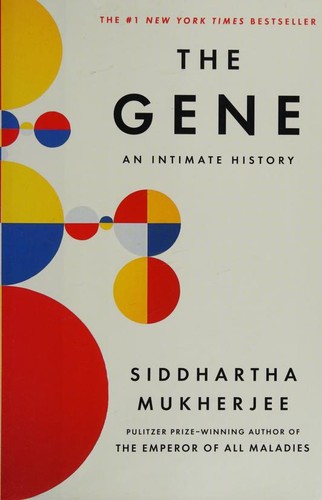
The Gene: An Intimate History
The thing I love about Mukherjee is that he takes deeply technical topics and not only makes them understandable, but turns them into stories you actually want to keep reading. The Gene is a perfect example. It is part science book, part history book, part memoir, and somehow all three at once. By the time you finish the book, you feel like you have lived through the whole arc of how humans came to understand heredity. But the bigger lesson I took from this book is something I did not expect going in: how much political and financial motivations shape what we call science.
You see these kinds of politics playing out in arguably the most important discovery in the field of genetics. Most people know the names Watson and Crick, but Mukherjee gives a lot of attention to Rosalind Franklin, the British chemist whose X-ray image of DNA (the famous Photograph 51) was central to figuring out the structure. Watson got a look at her image without her knowing, and the leap to the double helix happened soon after. Franklin’s contribution was largely overlooked at the time, and she died of ovarian cancer at 37, before the Nobel Prize was awarded. That meant she was not eligible to share it even if the committee had wanted to include her. It is one of those moments where you realize how much of science history depends on who got credit and who did not.
Another story that stuck with me was Nancy Wexler’s hunt for the gene responsible for Huntington’s disease. Wexler spent decades traveling to a cluster of villages around Lake Maracaibo in Venezuela, where Huntington’s ran through entire families generation after generation. Her team built a family tree of more than 18,000 people, all traced back to a single woman in the early 1800s who carried the gene and had a huge number of descendants. That painstaking field work is what eventually let scientists locate the Huntington’s gene on chromosome 4. It is a great example of how a single specific genetic variation can be tied directly to a disease, and how one person’s genetics can ripple through hundreds of years of human lives.
Unfortunately, Huntington’s is the exception, not the rule, and one thread Mukherjee keeps coming back to is that most genes do not act in isolation. The analogy that stuck with me is his framing of epigenetics. He compares genes to an object and epigenetics to the box around it, the context that shapes how the object gets used. Methyl tags can attach to genes and turn them on or off, and those tags can be triggered by your environment, including things like trauma, diet, and even other genes.
The most haunting historical example is the Dutch Hunger Winter of 1944 and 1945, when a famine in occupied Netherlands left lasting genetic signatures not just on the people who lived through it but on their children and grandchildren. The example that stuck with me was Mukherjee’s own family. His father had four brothers, and two of them developed serious mental illness. Mukherjee describes how the Partition of India in 1947, which uprooted his family from their home and tore the country apart, seemed to act as a trigger. The genetic predisposition was likely already there, but it took the trauma of Partition to bring it to the surface. Then in the next generation, his cousin Moni developed schizophrenia. The illness appeared differently across generations depending on what each generation lived through. Mukherjee returns to this story throughout the book, and it is what makes the whole thing feel personal instead of just academic. It is wild to think about how something your grandparents survived might still be shaping how your genes are read today.
If anything, this book taught me that science does not happen in a vacuum. It is shaped by who has power, money, and ego. Mendel’s landmark pea experiments sat ignored for over thirty years until three scientists independently rediscovered his laws around 1900. One of them, Hugo de Vries, was so frustrated about being bested by a dead monk that he initially published his work without even mentioning Mendel, and he later complained it was unfair Mendel was getting the credit. Decades later, the Nazis took early genetics research and twisted it into the foundation for eugenics, racial purity laws, and mass murder, and scientists who pushed back on the bad science were often punished or killed. The same thing happened in the Soviet Union, just with a different ideology. A man named Trofim Lysenko rejected mainstream genetics entirely and convinced Stalin that crops could be transformed through environment alone, which was nonsense. Real geneticists who disagreed with him were sent to gulags or executed, including Nikolai Vavilov, one of the great plant scientists of the 20th century, who starved to death in a Soviet prison. And it is not just authoritarian regimes. Another story that hit me hard was Jesse Gelsinger’s. Jesse was an 18 year old with a rare genetic disorder called OTC deficiency. He managed it with a strict diet and a long list of pills, but in 1999 he volunteered for an early gene therapy trial at the University of Pennsylvania because he wanted to help babies born with the more severe form of his disease. Sadly, the treatment killed him within four days. The investigation found that the lead scientist had a financial stake in the company developing the therapy, that warning signs in earlier animal studies had not been disclosed, and that Jesse should not have been enrolled in the trial in the first place. Whenever there is enough power, money, or ego on the line, science bends. Reading those chapters made me think about what scientific or factual things are being silenced or distorted today, in ways we might not even fully see yet.
The book ends with the ethics of genetic engineering, and this is where things really start to feel urgent. Mukherjee describes the Asilomar Conference in 1975, where the leading geneticists in the world voluntarily paused certain recombinant DNA experiments because they were worried about worst case outcomes. As Mukherjee notes, China has already crossed lines that American researchers have refused to cross.
My own takeaway is this: Genes matter, especially for things like sickle cell and Huntington’s disease where a specific genetic variation directly causes a clear outcome. But for so many other things, we are too quick to say “it’s genetic” when really we are looking at gene-environment interactions, epigenetics, and a jumble of factors we are still figuring out. Genetic therapy has incredible potential to relieve real human suffering, but it also has real potential to harm, and there is no putting Pandora back in the box. What makes The Gene great is that it is not just a book about genetics. It is a book about how knowledge gets built, how it gets misused, who gets credit, who gets forgotten, and what we do with the power that knowledge gives us. If you are curious about science, history, ethics, or just about people, I would highly recommend it. Like with any Mukherjee book, expect to feel a little smarter and humbled by the end.