#17 Favorite
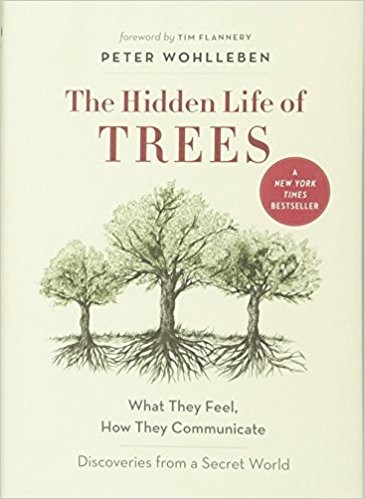
The Hidden Life of Trees: What They Feel, How They Communicate—Discoveries from a Secret World
The Hidden Life of Trees by Peter Wohlleben is one of those books that quietly changes how you walk through the world. Wohlleben is a German forester who spent over twenty years working in the forestry industry before leaving to manage a more ecologically minded forest in the Eifel mountains. The book is his attempt to share what twenty years of careful observation taught him about how forests actually work, and it makes you realize how much is happening in a forest that the average person walks right past.
I think people forget that trees are alive in part because they live so much longer than we do. A two hundred year old tree barely registers as old in its own community. A four hundred year old beech is still considered middle aged. We see a forest as a static backdrop, but it is actually a slow motion drama happening on a timescale we are not built to perceive.
Once you start looking closely, the dynamics in a forest are wild. There are real win-win relationships, like trees and fungi. The trees feed the fungi sugars from photosynthesis, and the fungi pull water and nutrients from a much wider area than the tree roots could reach on their own. Fungi also extend the tree’s communication network, allowing trees to send chemical signals to their neighbors.
The forest also has delicate balances. If a parasite kills its host tree, the parasite dies too, so even the parasites have an incentive to not be too aggressive.
There is slow violence as well. A vine choking out a tree. A storm ripping bark off a trunk, leaving the equivalent of an open wound that mold and rot will eventually find. When a tree falls and creates a gap in the canopy, every nearby tree starts racing to grow into the new patch of sunshine, and within a few decades the gap is gone. Everything is fighting for its place in what looks like a quiet, peaceful environment.
A few specific things stuck with me. One is that we still do not really know how trees get water from their roots to the top. Capillary action alone is not enough to lift water that high. Some combination of root pressure and transpiration is involved, but the full mechanism is genuinely not understood. It is one of those reminders that even something as common as a tree is still mysterious if you look at it closely enough.
Another is the relationship between coastal forests and inland rain. The trees on the coast pump water vapor into the atmosphere through their leaves, and that moisture gets carried inland by prevailing weather patterns and eventually falls inland as rain. If you cut down the coastal forests, the moisture cycle gets broken and the rain stops reaching the interior lands. The continent slowly dries out from the edges inward. That is not a metaphor, it is how the system actually works. It made me think about deforestation completely differently. It is not just losing trees, but also losing the rain that the trees were going to provide for everyone else.
The biggest lesson I took from the book is that the healthiest forest is one that people leave alone. Old growth forests, where trees of all ages grow together, are dramatically more resilient and more productive than the plantations we have replaced them with. Plantations look like forests but they are really just rows of trees that have no connections to each other, no elders, no fungal network, no community. They get hit harder by storms, droughts, and pests, and they recover more slowly. Nature, given enough time and left to its own devices, is better at creating a forest than we are.
One thing worth flagging if you do pick up the book. Wohlleben leans hard on anthropomorphism. He talks about tree friendships, tree mothers caring for their children, trees screaming when they are thirsty. Some scientists have pushed back on this framing as overstating what the science actually shows. The underlying biology is real (mycorrhizal networks, chemical signaling, transpiration cycles), but the emotional language is Wohlleben’s poetic interpretation, not established fact. I think the framing actually works for making you care, but it is worth knowing where the science ends and the storytelling begins.
If you want to come away with a much deeper respect for what is happening under your feet and over your head every time you step into nature, read this book. You will see the forest in a whole new light.