Guatemala
I had a week of PTO that I needed to burn, so I bought a cheap plane ticket to Guatemala.
I do not usually carry local currency when I land. I just wait until I get there and find an ATM. Cash matters in Guatemala because credit cards often get hit with a 7% surcharge or more. I use my Fidelity debit card for the international benefits. What I did not realize is that Guatemala City’s airport does not have an ATM inside the terminal. I am used to landing somewhere, clearing immigration, and finding a cafeteria or a nice waiting area to collect myself before figuring out transportation. Guatemala City is not that. There is no AC, and once you are through immigration you are basically two steps from the street, surrounded by a crowd of people waiting for their loved ones. As a solo traveler, it is a lot.
I had to wander out into the parking garage to find an ATM. I must have looked lost, because at one point a tall white guy with an eye patch and a thick accent walked up and asked if I was looking for one. Pro tip: even if you are looking for an ATM, it is not wise to let strangers help with your banking. I lied, said no, and walked away until I found one on my own. Then I got my quetzales (the currency is named after the national bird, which is genuinely beautiful) and ordered an Uber to the hostel.
I stayed in Guatemala City for one night (I would not recommend staying there for more than that as it is kind of dangerous) and headed to Antigua the next morning. Guatemala does not have orderly public transportation in the way an American or European would expect. They repurpose old American school buses, paint them in wild colors, and run them as a cheap intercity system. They are called chicken buses, supposedly because passengers used to (and sometimes still do) bring live chickens on board, and also because they get packed in like, well, chickens. They are cheap and very cool to look at, but as a solo American with a suitcase I figured I would stand out as an easy target. Looking back, I think I probably would have been fine. Just slower and hotter and more crowded. The right move if you are traveling with friends or have met people at a hostel is to split a shuttle or an UberX. I booked a shuttle through my hostel for about $15 to $20.
Antigua itself is beautiful, even if the humidity hits you the moment you step outside. I felt like I needed a shower every time I spent more than ten minutes in the sun. I took a walking tour and learned the city was once the capital of all of Spanish Central America. The Spanish picked it, and then kept rebuilding it earthquake after earthquake until they finally gave up and moved the capital to Guatemala City. You can still see which colonial buildings have survived three centuries of seismic activity, which is its own kind of architectural lottery. The cobblestone streets and the color palette are gorgeous. Antigua is a UNESCO World Heritage Site, so there are strict laws about how you can paint or modify the exterior of any building, which leads to one of my favorite details: the Starbucks in Antigua looks exactly like every other ochre-and-white colonial facade on its block. You expect a normal Starbucks and find a restored 1930s residence with a massive interior courtyard, a green wall, fountains, and local murals. It is regularly called one of the most beautiful Starbucks in the world. Worth a stop even if you would normally avoid the place.
The food was fine, not great. I tried pepián, a chicken stew that is one of the national dishes. It was good but nothing I would chase down again. The bigger issue for me was that the Guatemalan diet is heavy on refined carbs and light on protein. Even when I ordered something with chicken, there was not much chicken. Lots of avocado, beans, tortillas, and rice. The result is that I would finish a meal and feel hungry again forty-five minutes later, burning through carbs with nothing to sustain me. I know how this sounds coming from an American complaining about food in a developing country, but it is genuinely what I noticed, and it is the kind of thing that affects your whole experience when you are about to do a multi-day hike.
The highlight of the entire trip was the overnight hike up Acatenango and Fuego. Antigua sits in a basin surrounded by three volcanoes. Acatenango is dormant and tops out around 13,000 feet. Fuego is right next to it and actively erupts, sometimes multiple times an hour. The standard tour camps on the saddle of Acatenango and then runs an optional side hike up Fuego.
The hike up was hard. I was carrying a regular backpack with no hip support, so all the weight rode on my shoulders the whole way. Some people in our group got altitude sickness. Elevation hits everyone differently, which is part of why I put so much effort into fitness before I travel. Being in shape just opens doors to experiences you would otherwise have to sit out.
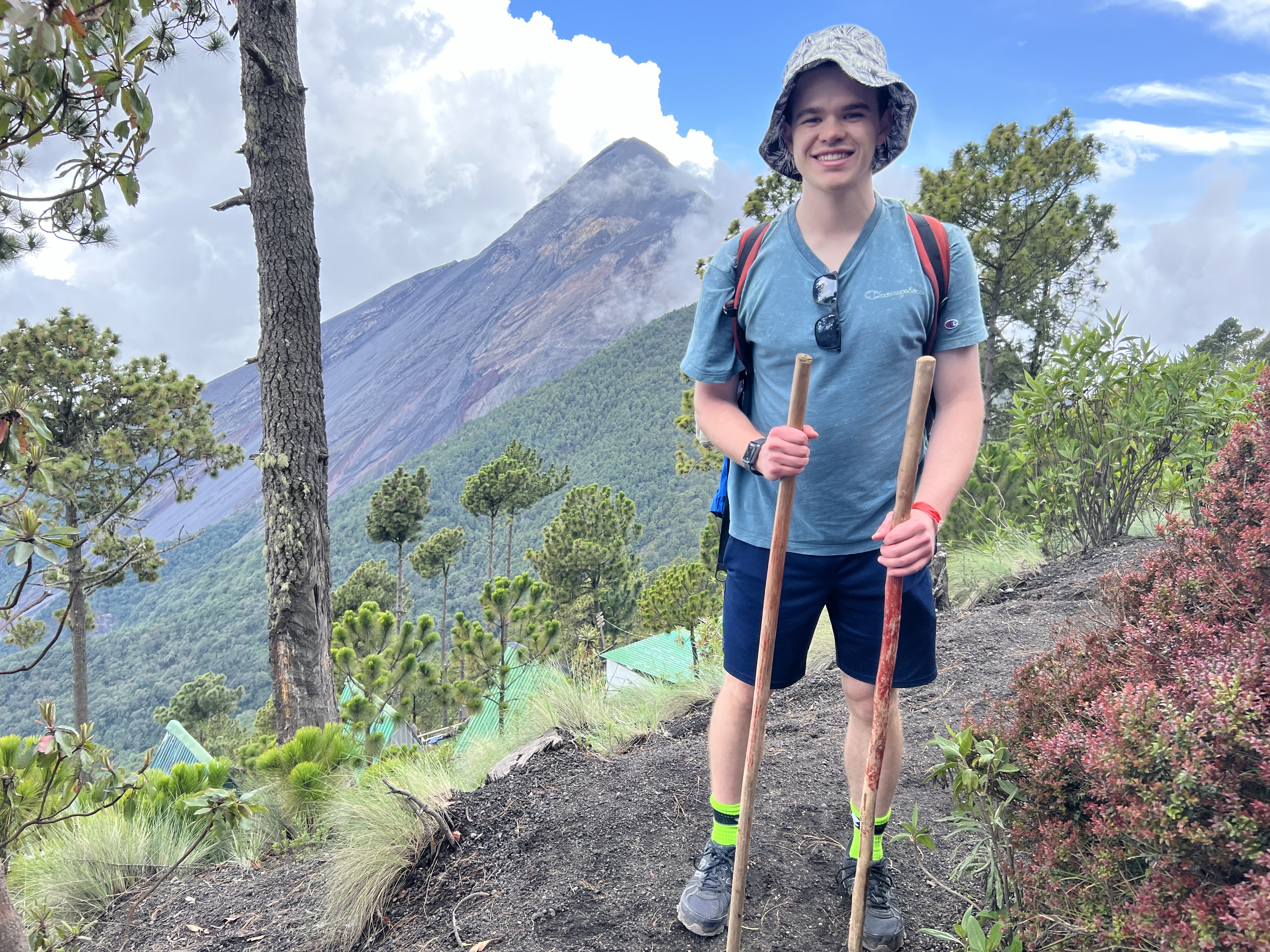
Once we made it up to camp on Acatenango, you could actually see Fuego erupting from across the saddle. The noise comes first, a low rumble, and then you look over and see lava arcing into the air with smoke billowing out. Everyone in camp stopped whatever they were doing and just stared. It is also visually wild because one side of Fuego is covered in lush green vegetation and the other side is just black ash from the eruptions.
After we rested, about half our group went for the optional Fuego summit attempt. We dropped down off Acatenango and started across toward Fuego, walking through these massive gulleys carved into the volcanic terrain. Our guide, Jaime, casually mentioned that just a few days earlier a tourist had died in one of these gulleys. It had started raining, the gulley filled with water faster than anyone expected, and the tourist froze. The water swept her down to the base of the volcano. He told us this while we were standing in the same gulleys. It is one of those moments that puts the weight of what you are doing into immediate focus, and it is also why having a competent and experienced guide matters so much.
We made it across and started up Fuego. At some point on the way up I looked up at how much more there was and genuinely thought I might have made a mistake. But I had not come all this way to bail because I was tired. We kept climbing as the sun set, and by the time we reached our viewing point it was completely dark, around seven PM. Jaime was already not sure we would get a clear view of an eruption because of how thick the clouds were. We waited, and sadly we did not see an up close eruption.
Then the wind picked up. Then it started lightly raining. Then we saw lightning followed by thunder. A Spanish guy in our group named Xavi looked at Jaime, visibly nervous, and asked “Uh, Jaime… don’t you think this is a little… dangerous?” Jaime looked at him and straight up responded, “What do you want me to say? No.” Looking back, that is the funniest line I have heard from a guide in my life. In the moment, it was my oh shit, we are not in the United States anymore moment.
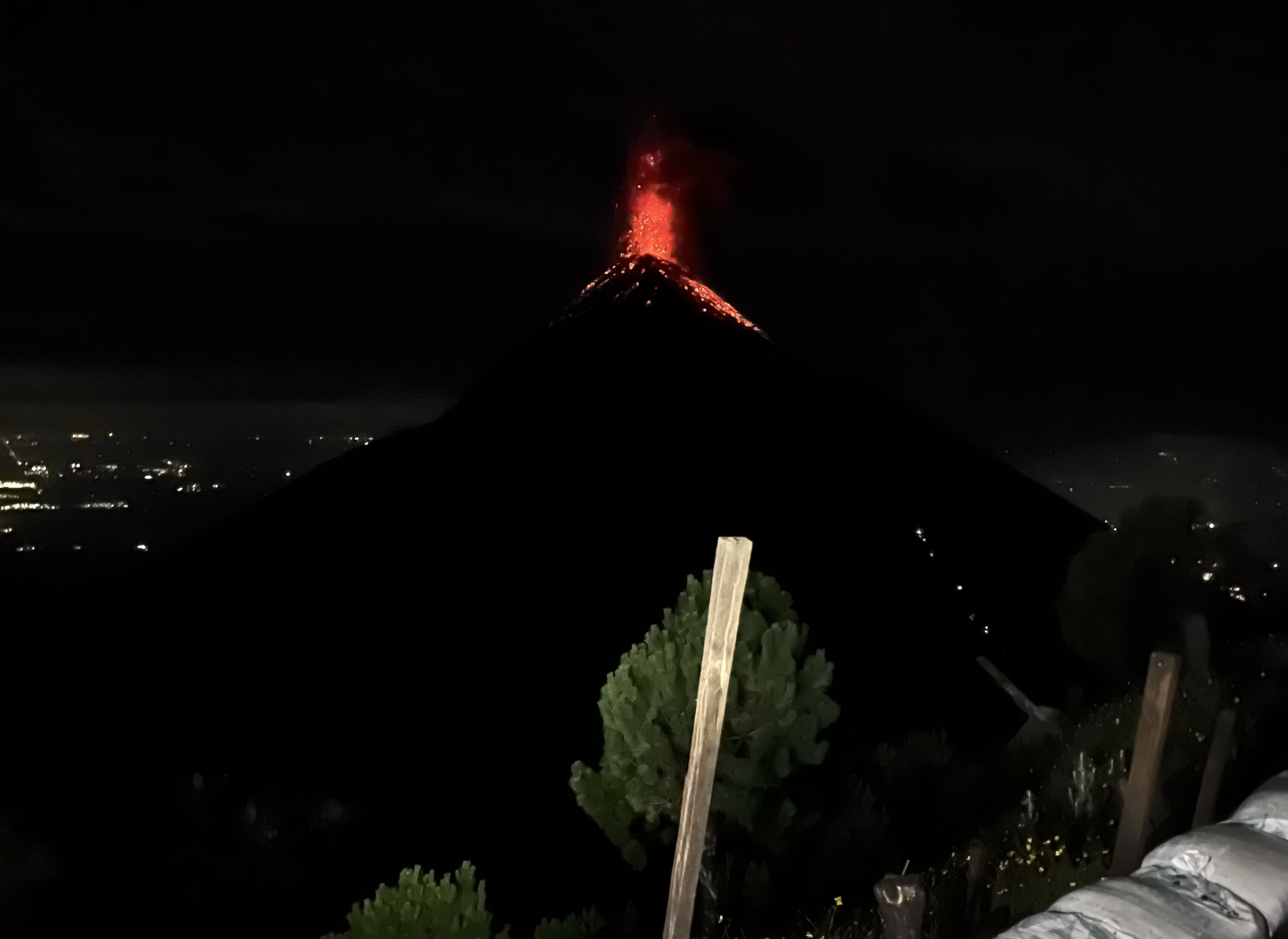
A few minutes later it was pouring hard. We had to start moving back to camp at Acatenango where the rest of the group was. Everyone had headlamps but they only lit a few feet ahead of you. Mine was almost dead, and Jaime gave me one of his spares. The rain was filling those same gulleys Jaime had just told us about. One wrong step and you fall in and the water carries you to the bottom of the volcano. I lost count of how many times I reached out with my walking stick expecting ground and found nothing, just open air over a moving river. A French girl next to me kept saying “I’m scared.” I did not know what to tell her. All I could think to say was just take one step at a time. It brought me back to playing competitive tennis as a kid, when I would get so nervous during a match that the only thing I could tell myself was play it one point at a time.
We eventually made it down off Fuego and then had to do the hour-plus hike back up to camp on Acatenango. I had eaten all my Clif bars. I was at the back of the group hiking slowly, and I remember Jaime calling out to the group “chicos, todo bien?” and getting back a flat “sí,” and then a moment later, separately, “Evan, todo bien?” Maybe I was not in quite as good shape as I thought.
When we finally made it back to camp I gave Jaime a hug. A few of us sat in the cabin trying to process what had just happened. “What the heck was that?” Xavi said something I have not stopped thinking about. He said you read stories about tourists dying abroad and you laugh and call them stupid. Then he paused and said that could have been us. I sat by the fire that night soaked, freezing, shivering, eating dinner slowly because if I ate any faster I would vomit. There were stray dogs around camp, and at one point one of them positioned itself between me and the fire. I had to shoo him away, and I was definitely not letting him walk off with my dinner either.
The next morning, despite all of that, we got up at three AM to summit Acatenango for sunrise. It was another brutal hike, and the view from the top might genuinely be the best view I have ever seen. It was worth every step.
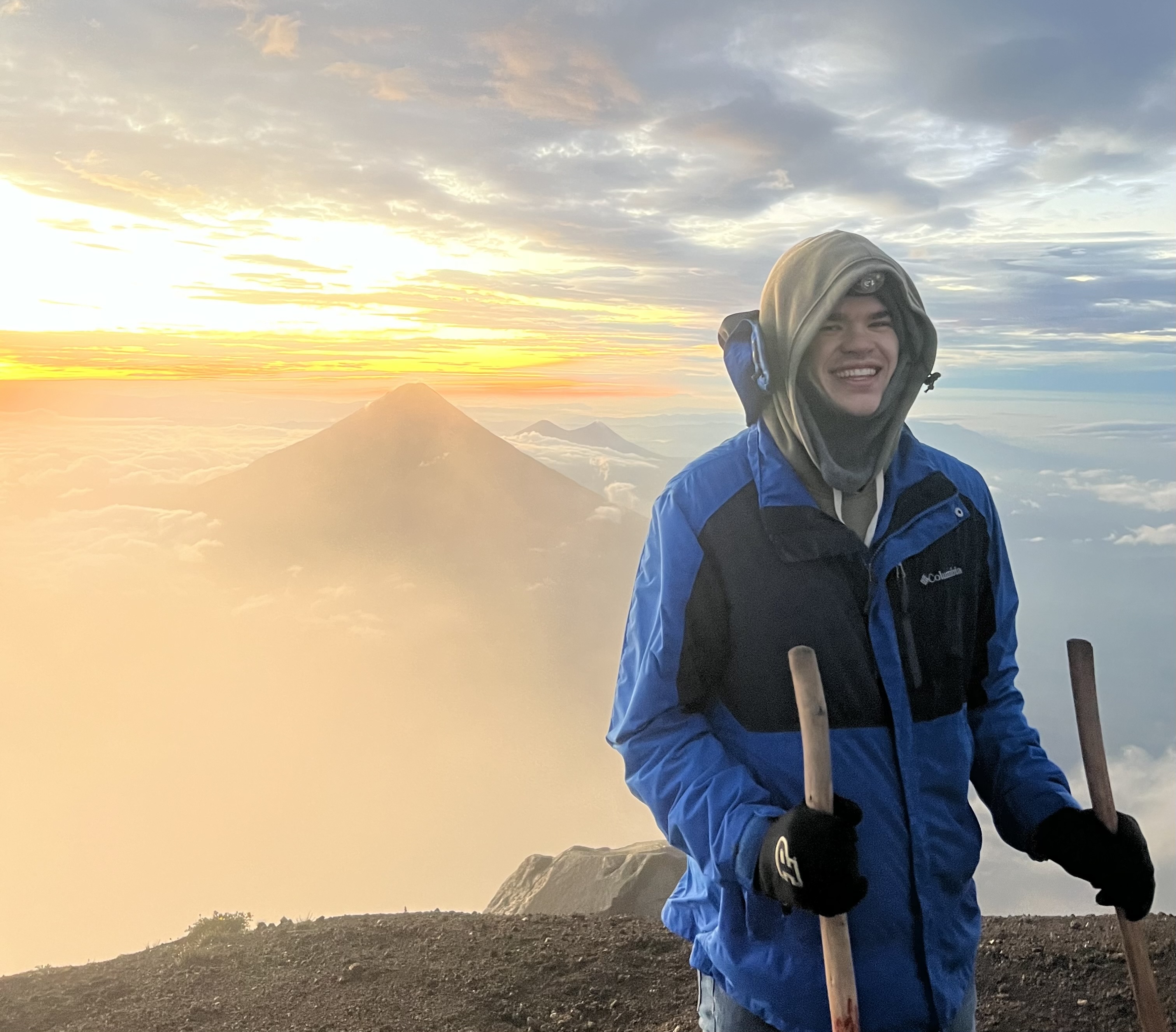
One strange detail: the wind at the summit was almost violent, but a few steps down the slope you felt nothing. After sunrise we came down, packed up, and hiked back to base camp. The descent was a lot easier than the climb up, partly because I had eaten and drunk most of my supplies. I was exhausted, but it felt like a real accomplishment.
I spent a couple more nights in Antigua. I celebrated the birthday of a new friend from Spain that I had met at the hostel. We went out to the bars with a group of people, and I ended up talking with a Guatemalan girl in our group named Jennifer. At some point she realized there were more Europeans in our group than actual Latin Americans and she was not happy about it. She started counting people off by their nationality. Spain, Spain, Spain, Guatemala, Colombia… and then she got to me. She looked at me and said “Evan, you’re Latino, right?” I replied “Nope, I’m gringo.” She shook her head and said “No, tonight you’re Latino.” Being made an honorary Latino in Guatemala was a pretty cool feeling.
From Antigua I took a shuttle to Panajachel, the main town on Lake Atitlán. The lake is sometimes called Bitcoin Lake. The nearby town of San Pedro La Laguna and the broader area have been part of a real Bitcoin experiment. There are Bitcoin ATMs all over the place, the logo is plastered on shop windows, and a lot of businesses accept it as payment. It was a fun thing to see in person. You expect a Bitcoin experiment to happen in a place like Singapore or Zurich, not in a small town on a Central American lake. The locals are happy to accept it because they can exchange it for quetzales or US dollars, but I did not see anyone Guatemalan-born paying for their groceries in BTC. It felt less like a functioning parallel economy and more like a tourist novelty layered on top of a normal one.
The highlight of Panajachel for me was paddleboarding on the lake. My guide said he thought the water was clean. Guatemala does not have especially strict environmental regulations, so who knows what is actually getting dumped in there. So I tried hard not to fall in.
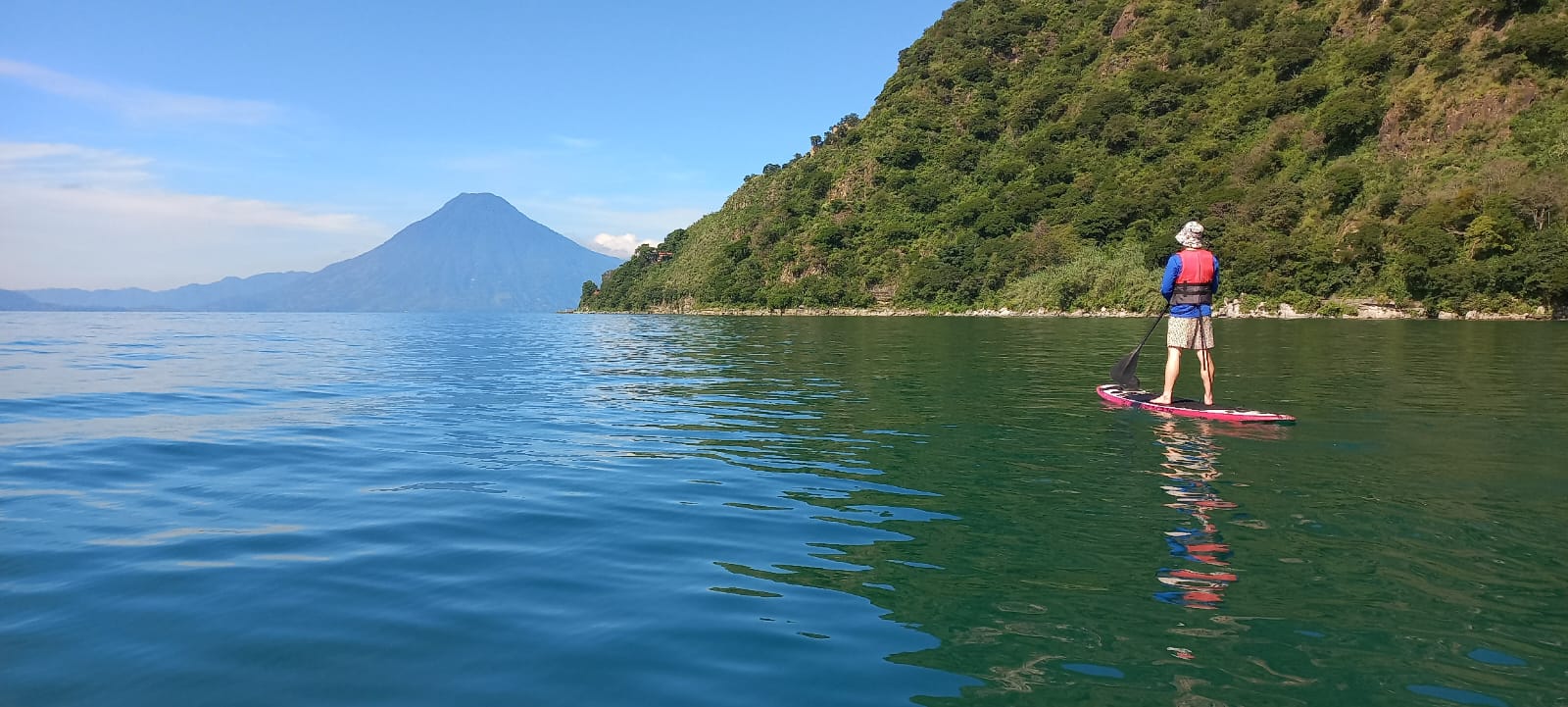
The lake itself is genuinely stunning. You stand out there surrounded by three volcanoes in the sun, and it does not feel real.
My last day in Panajachel happened to be Guatemalan Independence Day. There were loud parades through the streets with schoolchildren marching and celebrating. It was great to watch. Coming from a city where every parade feels like a sampling of the whole world, seeing such a tight, shared Guatemalan identity on display was its own kind of moving.
On the shuttle back to the airport I got more Independence Day. Apparently the tradition is to throw water balloons and full buckets of water at moving cars, which feels mildly dangerous to me. You also see kids riding on top of moving chicken buses, dancing and celebrating. At some point I just accepted it. Rules in Guatemala are certainly not the way they are in the US.
Guatemalan drivers are also genuinely terrifying. We were weaving through mountain roads and our shuttle driver decided to pass the car in front of us on a one-lane curve where you could not see fifty feet ahead. Halfway into the pass I saw a car coming straight at us in the opposite direction. My heart stopped. We made it, somehow, but that was way too close.
I also probably got mildly sick toward the end of the trip. Not the kind of sick that stopped me, but the kind where about thirty minutes after every meal, everything I had eaten was suddenly on its way out. I do not think it was the water. I think it was the grease from some of the meat. I always lose seven or eight pounds when I travel and this was a big reason why.
Experiencing a Guatemalan national celebration also got me thinking about the country more broadly. Guatemala is dealing with serious brain drain. The most ambitious people often try to leave for the United States or Europe, and you can read a lot about how a country is doing by which direction its people are moving. Guatemala is still recovering from a long civil war, corruption is endemic, much of the population is rural and subsistence farming, and there is not much investment in tech or higher-productivity industries. The people I met were genuinely kind and the country is beautiful, but the underlying quality of life is just a different tier from what I am used to. It was sad to see so many middle-aged people who looked years older than they were, the result of decades of refined carbs and intense UV exposure.
The flip side of that observation is one I do not think about often enough. I am lucky that so many of my friends who grew up in the US have stayed. I am lucky that so many people I have met in Indiana come from all over the world. The same forces that drive Guatemalans to leave their home are the forces that bring people from other places to mine, and I think it is easy to take that for granted until you see what the other side of the equation looks like. Guatemala is a great place to visit. I would not want to live there. And honestly, the immigration patterns suggest most people would agree with me.
Overall this was one of the most memorable trips I have ever taken. I am not sure I would go back, but I am very glad I went at least once. Cost-wise it was a little more expensive than I expected, honestly comparable to what I spent in Portugal once you add everything up. Some experiences you only get to have once, and Acatenango is worth being ready for.
If you go on the volcano hike: Bring a proper hiking pack with a hip belt and pack light. The food the guides provide on the volcano is refined-carb-heavy and not what you want as fuel, so bring a stack of Clif bars. They are compact, calorie-dense, do not melt, and have actual protein. I wish I had brought twice as many. Bring water, but not too much. Water is heavy. Bring sunscreen and reapply constantly, because the UV gets significantly stronger as you climb, even when it feels cold. A long-sleeve sun shirt and a hat help. Bring layers for night. Walking sticks and real hiking shoes are non-negotiable, especially for the way down. Get a good guide. Train before you go. And study your Spanish!!! Or at least bring someone that can translate for you.