India
I spent two years in engineering grad school working alongside one of my closest friends, Junaid. He is from India. Later on, I introduced Junaid to my other good friend Colin, and the three of us kept up after I graduated. At some point Colin started asking Junaid if he could come to India with him, and I had enough FOMO that I jumped in too. So we all bought tickets and went.
Pre-trip there was a lot of excitement and nerves. Colin’s family kept asking him if he had everything he needed for the trip. His response: “I’m pretty sure India has stuff.” After we boarded the plane, he leaned over and said, “Thank goodness they gave us a toothbrush on this flight because I totally forgot mine.” We had bought the cheapest tickets we could find, which meant the three of us were sitting in different rows. Halfway through one of the legs, I was half-asleep when I heard “pssssh, Evan.” I looked over and laughed as Junaid and Colin were just standing by the emergency exit hanging out. I got up and joined them, and the three of us stood there chatting while we let everyone cut us in line for the bathroom. That was basically the entire trip in miniature: the three of us, doing something a little ridiculous, having a good time.
India does not let Americans in without a visa, and the visa process is the sketchiest I have ever seen. The official website looks like it was designed by a fourth grader. I was complaining about it to my Indian friend Shreyansh back home, and he replied by sending me the link to the Indiana BMV website. Touché. The tourist visa cost $25, and all you get is an email confirmation. No PDF, no QR code, just one email you have to print out and present when you land. The sketchy visa portal turned out to be a fitting preview. A lot of India works like that: a little chaotic, a little baffling, but ultimately functional.
We landed in New Delhi and barely spent any time there before getting on the train to Junaid’s hometown in Rajasthan, a city called Bhilwara. Even that short time in Delhi was enough to notice the air. Junaid’s dad picked us up at the station and brought us back to the family home, which was beautiful. Tiled everywhere, lived-in across generations, and his family was unbelievably warm. I think Colin and I might have been the first white people his parents had ever met in person. They welcomed us like family.
Bhilwara was where the culture shock hit. The city is constant motion and noise: cows wandering everywhere, mopeds and horns, stray dogs and cats, burning trash, almost no sidewalks. Walking around town one day, Colin said something to the effect of “everyone here is being so nice to us.” Junaid laughed and said, “No bro, they are being rude. You just don’t understand what they’re saying.” That was the first time it really clicked for me how dependent we were going to be on him for the next two weeks.
Even though English is technically an official language of India, only about 10% of the population actually speaks it. The Indians who immigrate to the US tend to be highly educated, which is why their English is so good and which gave me a skewed sense of what to expect on the ground. Junaid being our translator was not a nice-to-have. It was the only reason we could function in most of the places we went. He was also our cultural translator. Moments like the “they’re being rude, you just don’t understand” one happened constantly. Junaid would often lean over and quietly tell us what was actually going on and answer all of the questions we had while experiencing India.
The food at home in India was also its own education. I was raised to clear my plate. In India, doing that signals you want more. Junaid’s mom kept refilling our plates, and even with my appetite I could not keep up. Everything was delicious. The chai and the mango smoothies stood out in particular. The other thing that stood out at the house was the morning call to prayer. Junaid’s family is Muslim, and there are several mosques in the neighborhood. I learned what 5 AM in a Muslim Indian neighborhood sounds like the hard way, when loudspeakers from multiple mosques started competing to see who could be the loudest. Just when you think the prayers are winding down, there is a grand finale that is louder than everything before it. Not a great way to get over jet lag.
Our first real day trip from Bhilwara was to Chittorgarh to see some forts and museums. The monkeys caught me off guard. They are everywhere, they are creepy, and I had heard stories of monkeys trained to steal phones and wallets from tourists. I spent the day on edge. We also visited a Jain temple, which was beautiful. While we were walking around the fort, Junaid mentioned that Chittorgarh had been the site of major protests and violent threats a few years back over a Bollywood film called Padmavati. The local Rajput community felt the movie distorted the legacy of a queen they consider sacred, and the protests included effigy burnings, threats against the lead actress, and vandalism inside the fort itself. It was wild to me that a movie could provoke that kind of reaction, but the legend of Rani Padmini is deeply tied to local identity in Chittorgarh.
After our day trip to Chittorgarh, we came back to Bhilwara. We met up with some of Junaid’s friends and rode mopeds through the city. The streets were almost empty after dark, which made it genuinely fun. At one point we were walking through a dark alley when two bulls came charging down it at full speed. Colin and I flattened ourselves against the wall until they passed. Junaid and his friends laughed and told us the bulls were just playing. We also visited Junaid’s old mosque, which was beautiful, and again almost no one there spoke English. Junaid kept us afloat.
From Bhilwara we took the train to Jaipur to visit Junaid’s sister. Indian trains are not the cleanest, especially if you do not know your way around a squat toilet. But I liked that you can lie down horizontally on the train’s seats and actually nap. The train was also where India really opened up to me. Looking out the window for hours at a time, I saw more poverty than I had ever seen in my life. Slums built out of trash. People hauling blocks of cow dung as fuel. Rural farmers working land with no industrial equipment. I kept asking myself why so much of the country was using such archaic technology when better tools clearly exist.
The answer I found that made the most sense came from Why Nations Fail. The political incentives in India work against industrialized agriculture. More industrialized agriculture means more rural unemployment, and India is a democracy with hundreds of millions of rural voters. So the technology stays old on purpose. Corruption compounds the problem. I had read that Agra is a major beef exporter, which is jarring given the religious significance of cows. Public infrastructure funds get embezzled. Price caps keep crop prices low, which keeps farmers poor and limits their ability to invest in equipment or education. None of this is a secret. It is just hard to fix.
When we got to Jaipur, Junaid’s sister and her husband were incredibly kind. They gifted us traditional Rajasthani shirts that I still have. After we left their place, we went to visit Junaid’s friend Rak closer to the city center. Rak is Jain, and I had already learned a bit about Jainism through my friend Shreyansh back home. The core principle is non-violence toward any living thing. While I was sitting in Rak’s home, a mosquito was flying near me, and without thinking I swatted at it, partly out of reflex and partly out of malaria paranoia. Colin’s eyes went wide and he hissed, “Evan, they’re Jain!” Luckily I never got malaria, and I do not think Rak noticed.
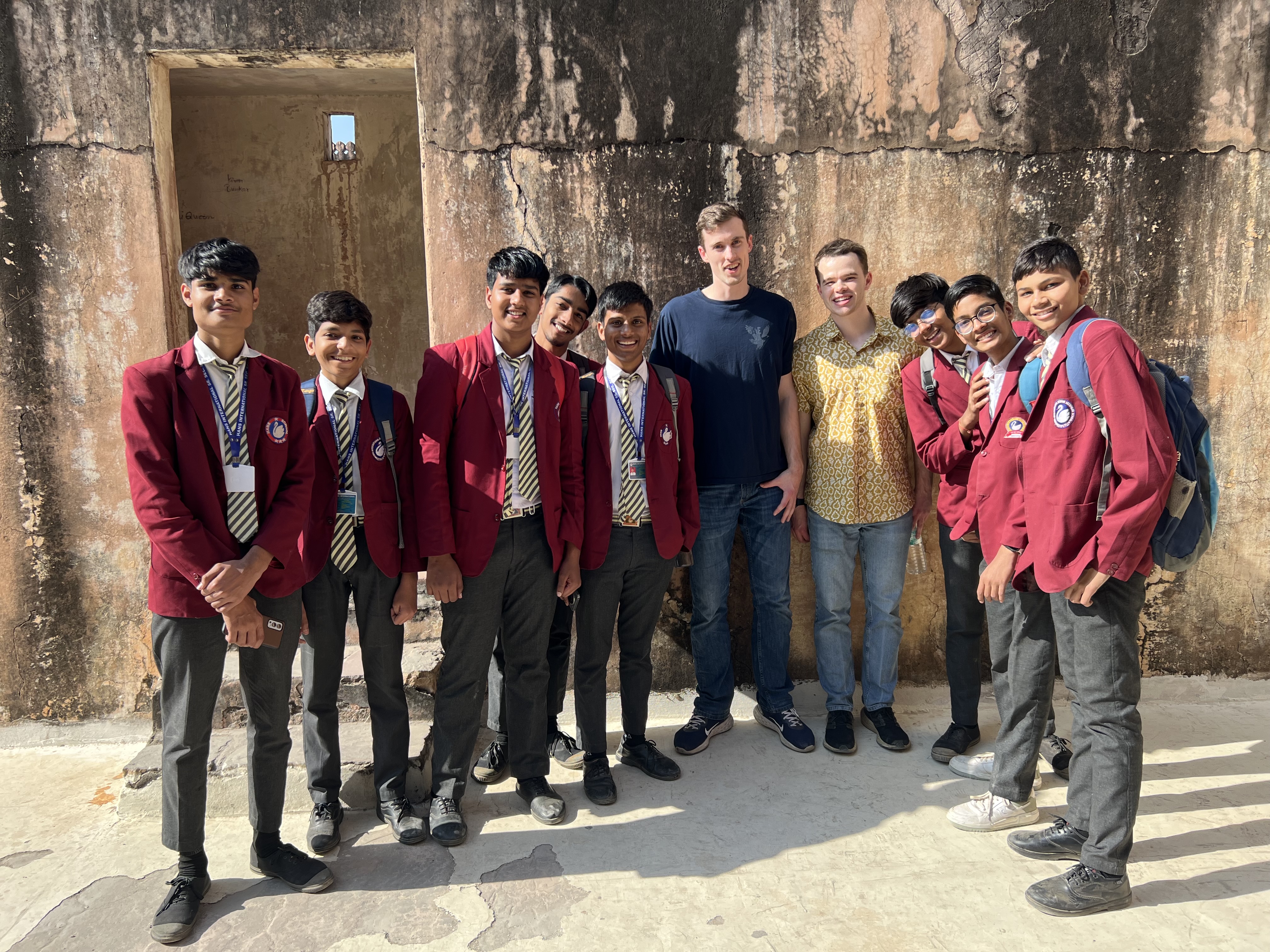
In Jaipur we saw the major sites: the Hawa Mahal, several forts, palaces, and museums. American tourists in India are rare enough that being white makes you a low-grade celebrity. A group of schoolchildren spotted us at one fort and asked if they could take a picture with Colin and me, and if Junaid would be the one to take it. After the photo, Colin started chanting, “USA, USA, USA.” I am surprised we did not get deported.
Walking around Jaipur outside of those moments was rough. The city was filthy, the sidewalks were nonexistent, there was trash everywhere including burning trash, and there was constant overcrowding and visible poverty. When I went to blow my nose, the boogers came out black. We got hassled constantly for tuk-tuks or for money. I am glad I saw Jaipur, but I would not go back, and I would especially not recommend it for women or for anyone traveling without a local guide.
From Jaipur we took an overnight bus to Rishikesh. Before the bus left, I told Colin there were no bathrooms on board and he should go before we pulled out. We asked the driver where the nearest bathroom was and he pointed at a wall. He was serious. You do what you have to do.
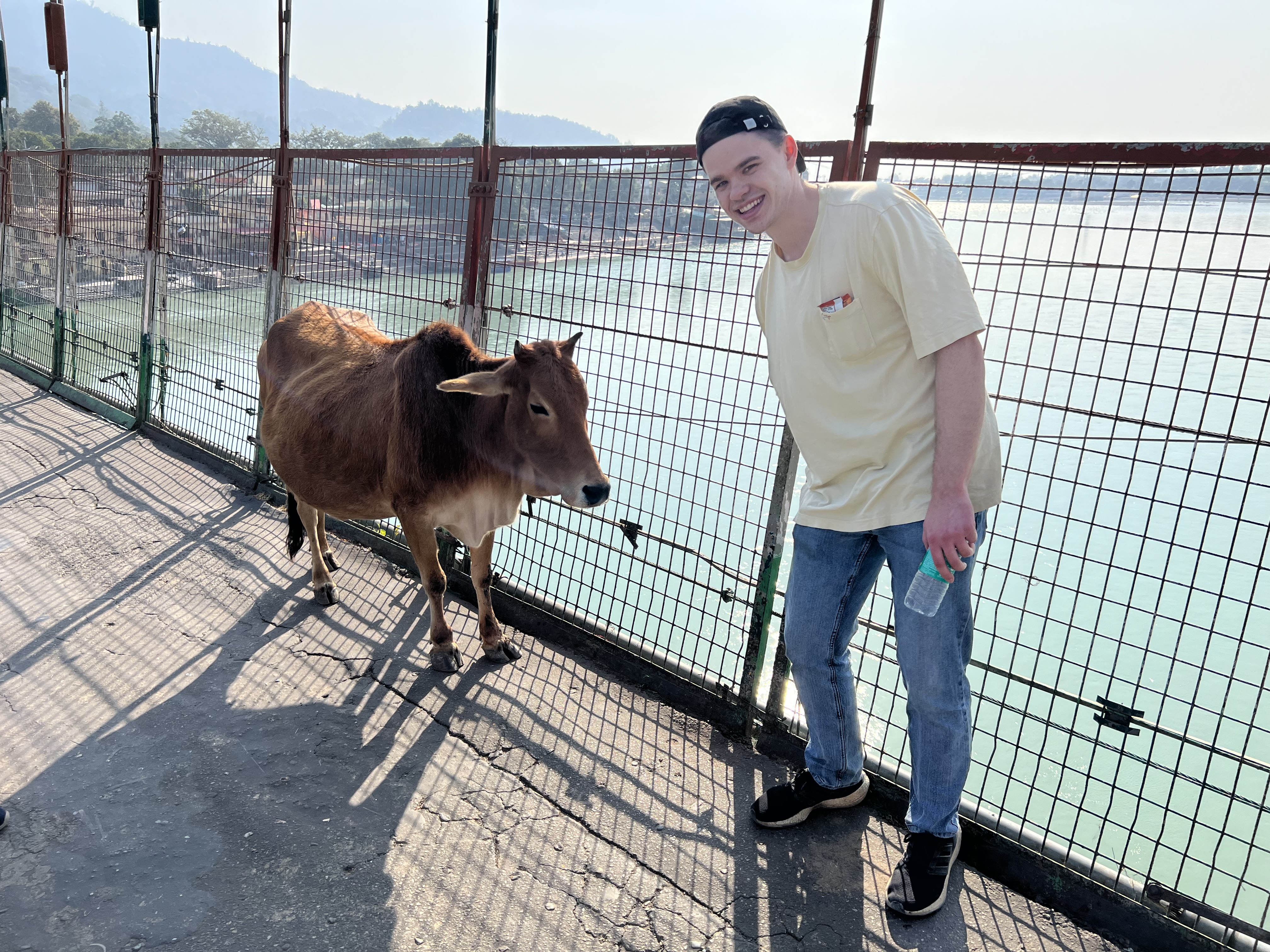
Rishikesh was a real change of pace from the rest of the trip. More touristy than Bhilwara or Chittorgarh, but not overwhelmingly so. The air was cleaner, the streets were cleaner, and the whole atmosphere was different. Rishikesh is considered the birthplace of yoga, and there is a beautiful bridge over the Ganges that everyone, including cows, crosses constantly.
We watched a nice Hindu ceremony where priests were worshipping the river. Rishikesh is also majority Hindu, which means no meat in the restaurants. That was hard for me to adapt to.
We tried to push farther north into the Himalayas to a town called Chopta, but the combination of altitude, a manual transmission, sitting at the back of the bus, and a relentlessly winding road broke Colin. He got the worst car sickness I have ever seen. I remember him stumbling off the bus and vomiting on the ground while locals yelled “tuk-tuk, tuk-tuk” at us trying to get a sale. That was the moment I was most fed up with India. The kindness of Junaid’s family and the beauty of the Ganges had been carrying me through, but watching my friend throw up while people tried to sell us a ride hit a wall. I wish we had made it to Chopta, but the ride alone was brutal and it was going to be freezing up there. Maybe next time.
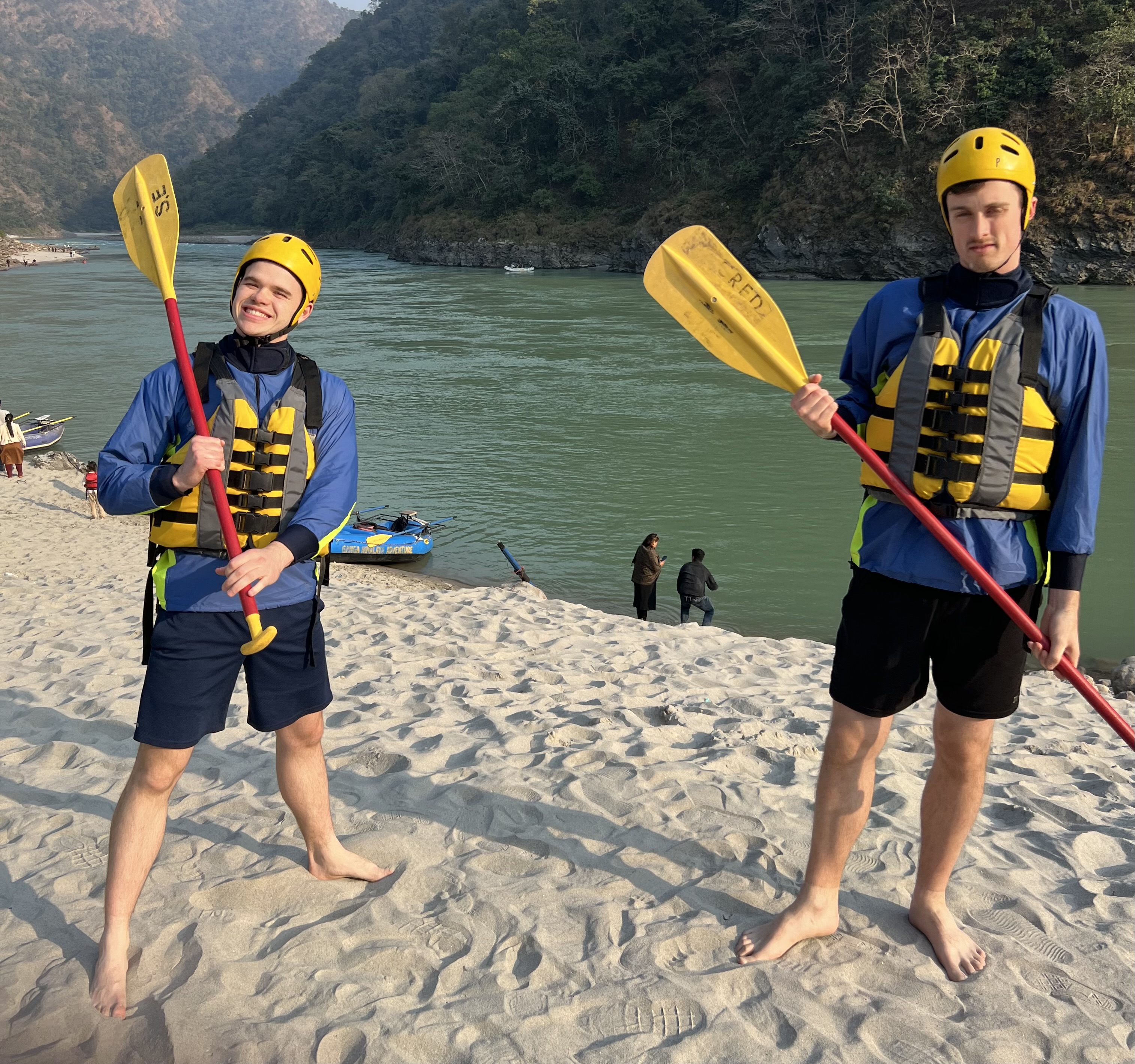
The day after, we went white water rafting on the Ganges, which made up for it. The water that far up the river is glacial melt, which means it is cold, clean, and actually drinkable. Our guide told us we could swim at one point, so I jumped in for a bit. Freezing, but worth it. Just do not do this farther downstream, because the lower Ganges is heavily polluted, partly because Hindus scatter the ashes of their dead relatives into it.
From Rishikesh we caught the train to Agra to see the Taj Mahal. We rolled into Agra around midnight, starving, especially since there had been no meat in Rishikesh. We found a small Muslim-run restaurant and ordered three plates of chicken. Maybe we were just that hungry, but the chicken was incredible. I am pretty sure they slaughtered the birds in the back, which is about as fresh as it gets. Even though we were close to the Taj, you could tell the family running the restaurant was not used to American tourists. A lot of restaurants in India are family-run, and we made a habit of encouraging the kids working at them to keep studying and keep practicing English.
We met two Dutch guys named Rick and Bas at a restaurant in Agra. I have a lot of respect for Dutch travelers, and we decided to team up for a few days. Honestly, one of the best parts about traveling with the Dutch is that they are taller and whiter than Colin and me, which meant they pulled a noticeable amount of attention away from us. It was brilliant. Rick and Bas loved traveling with us because of Junaid. They called him by his last name, Ali. I remember Bas saying, “I don’t know how we could do half the stuff we are doing without Ali.” He was right. Junaid was a lifesaver.
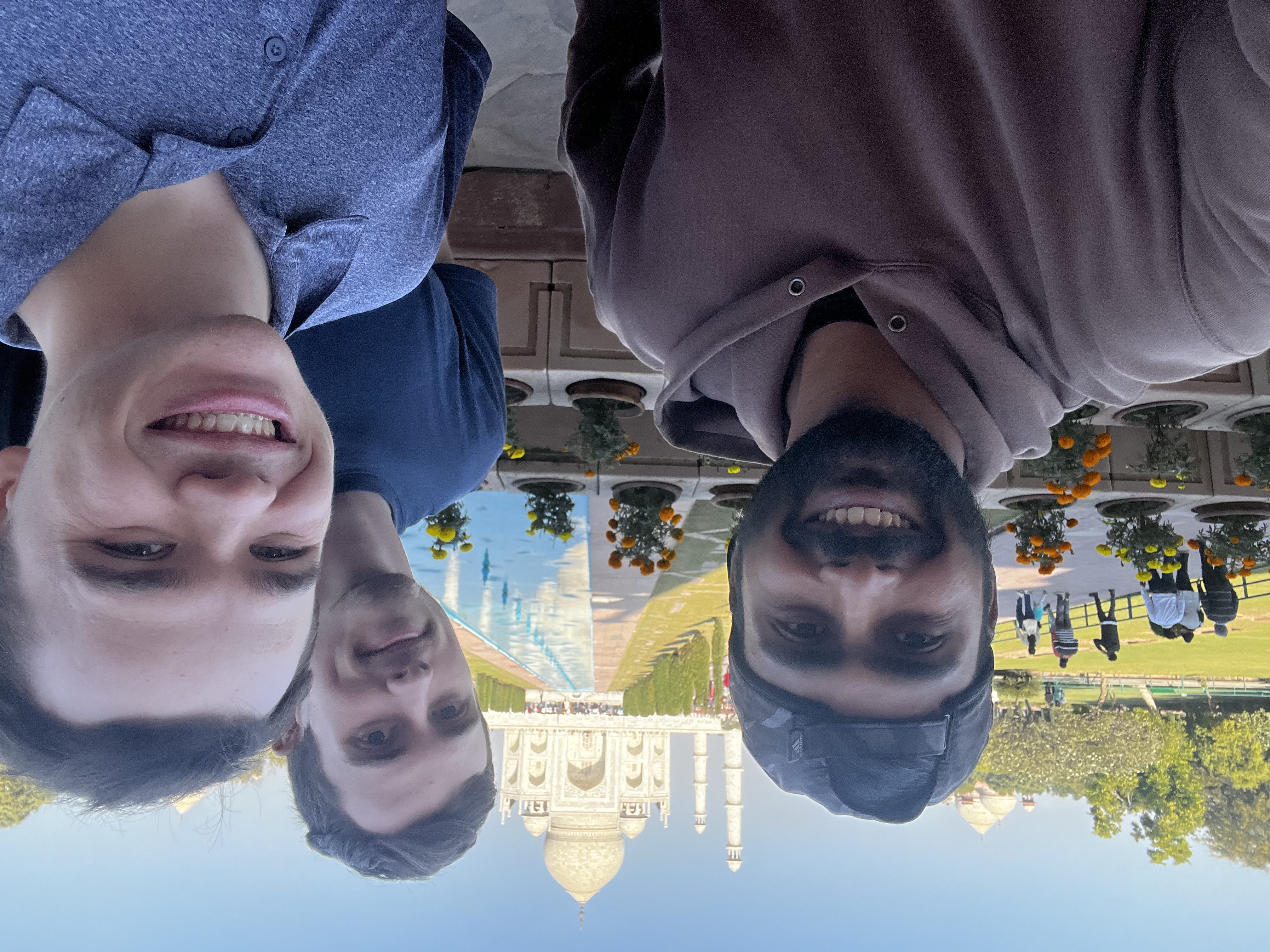
The Taj itself was the cleanest place we saw in all of India. It is magnificent from the outside and a little smaller than I expected on the inside. It was the first wonder of the world I have ever visited and I was just grateful to be there.
We saw a bit of the Red Fort after, and then headed off to Sawai Madhopur for a safari.
The shared taxi to Sawai Madhopur was an eight-hour ride in a car powered by natural gas. I did not realize the car was natural gas powered until we stopped to refuel, and they made me get out of the car. I asked why, and they told me the car could explode. Natural gas is dirt cheap there, which explains why Ubers in India are so affordable. I caught myself wondering why the US does not run more cars on natural gas, and then I remembered the part about the car potentially exploding and decided that was probably a fair reason.
The safari was supposed to be all about tigers. We did not see any. We saw a lot of deer. Eight hours of driving for deer. Another classic Indian scam, and by that point in the trip it had started to feel like a pattern. India is genuinely cheap, but as a foreigner you pay a tax. Right before a museum visit earlier in the trip, Colin had warned me that foreigners are charged ten times what Indian nationals pay for admission. I said that was outrageous, and he told me the foreigner price was two dollars. Fair. But it kept happening in less amusing ways. Junaid would order a tuk-tuk, ask the price, and the driver would jack it up the moment he saw the rest of us. A hotel manager once chewed out one of his employees for not charging us the inflated rate, calling her an idiot when she had just wanted to give us a fair deal. Even something as basic as finding an ATM had multiple strangers walking up and offering to “help” us, which is exactly the kind of help you should never accept when foreign currency and your debit card are involved. We always politely declined and figured it out ourselves. Beggars and tuk-tuk drivers would lock onto us once they spotted us. Colin took to calling them zombies and would nudge me when one was trailing behind. One woman would not leave us alone after the safari, and eventually Junaid and a couple of other Indians around us said something to her. She went on a long rant and walked off. I had no idea what she said. So I asked Junaid, “Did she put a Hindu curse on us?” Junaid replied, “Yeah bro.” Colin and I got a good laugh out of it. Whenever something like that happened, Junaid would just shake his head and say, “Indians just being Indians.” After two weeks of traveling, I started to understand.
The smaller, everyday version of all this was lines. India does not really have them. At the airport help desk, the train station, the bathroom stall, anywhere people are waiting for something, there is no line. There is a blob. You can be next to be helped and someone will walk up and physically insert themselves in front of you, and nobody around them will say anything. It is a small thing, but it frustrates you after a few weeks. It is also one of those things that makes you think about how much corruption at the top of a country shapes what people do at street level. When the government does not enforce fairness in the big things, people stop expecting it in the small ones.
Eventually we said goodbye to the Dutch and made our way to Delhi by train. You always meet interesting people on Indian trains. One guy walked up and started talking to me, then pulled out his phone and started FaceTiming his family to show them he was meeting Americans. I had no idea what he was actually saying because he did not speak English. I just wanted to sleep.
We checked into our hotel in Delhi, and the next morning I had to blow my nose at breakfast. I could not find a trash can anywhere. A doorman saw me, smiled, and offered to take the tissue off my hands. I thanked him. Then I glanced back to see where the trash actually was in case I needed to use it again. I watched the doorman open the front door, step outside, and toss the tissue directly into the street. At that point nothing in India surprised me anymore.
That afternoon we met up with Junaid’s cousin, who he kept calling his sister. Indians refer to cousins as brothers and sisters, which threw me for a second because I thought we had already met his only sister. Junaid’s cousin was great. She worked for a French IT company and spoke excellent English. Walking through the streets, a kid started yelling at Colin and me and was rudely asking for money. Junaid’s cousin tore into that kid so fast he sprinted away. I just stood there in awe. Why had she not been traveling with us this whole time?
We walked through India Gate that night with it lit up. Genuinely beautiful.
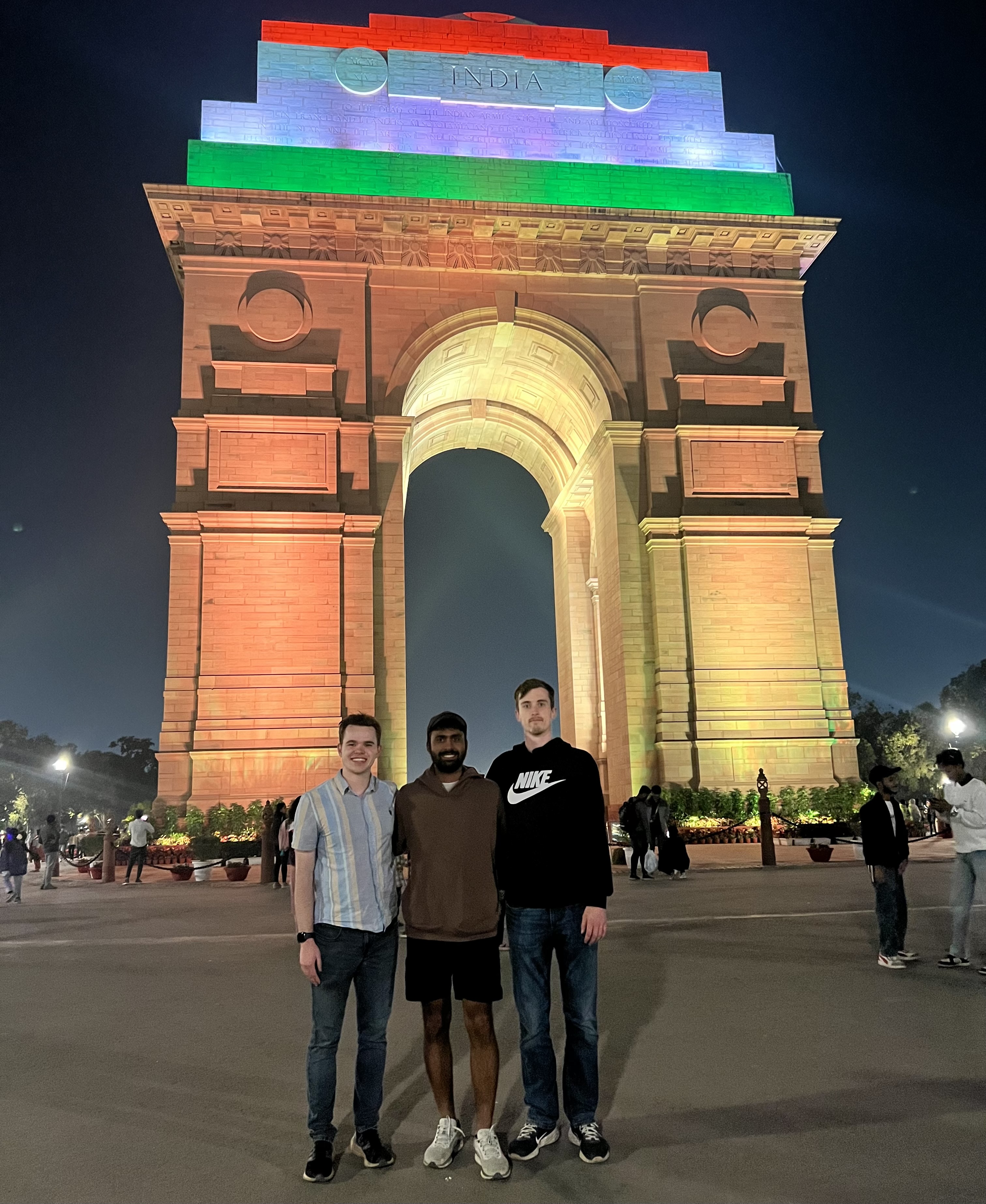
We said goodbye to Junaid’s cousin, and the next morning Junaid headed back to be with his family. Colin and I spent our last day wandering Delhi and buying gifts. It was strange having to navigate the city without Junaid, but by then we had been there long enough to handle it (barely).
At the airport, while we were waiting to board, Colin made friends with a Russian-speaking traveler and started practicing his Russian on him. The guy understood Colin but only replied in English. Then, when it was time to board, security pulled Colin and me aside and made everyone else board first. They thought we were Russian spies. They asked for our passports, exchanged a few words in Hindi, and immediately waved us on. Man, I love flexing my US passport. (Pro tip: do not eat the food on the flight back. It is not prepared with safe water, even in first class. I learned this the hard way and was sick for three days after landing.)
This was one of the most memorable trips I have ever taken. The hardest parts of it were honestly easier to laugh about now than I expected. We could never have done this trip without the help of Junaid, and Colin always made us laugh during the harder moments. Going to India also gave me a much deeper understanding of where my Indian friends back home come from and what they grew up around, even though there is still so much I do not know. I probably would not go back right now. But I do hope that in twenty years I can return and find that the country has changed dramatically for the better. The people I met along the way deserve it.