Switzerland
I had wanted to go to Switzerland for years. Most of that desire traces back to one person: my Swiss colleague Andy Schmid. Andy and I are great friends and met at work. We would joke around at the office, drink coffee, swap stories, and I got to practice my German with him every day. The running joke was that I had gone to Portugal and gotten food poisoning, gone to Guatemala and gotten food poisoning again, gone to India and gotten food poisoning a third time, and Andy would just shake his head and say I wouldn’t have gotten sick if I’d gone to Switzerland. I kept telling him Switzerland was too expensive for me. He kept telling me to go anyway.
In early 2025, Andy told me he and his family had decided to move back to Switzerland that summer. I was genuinely sad to see him go. We sent him off with a proper goodbye, and I told him that now that he owned a house in Switzerland, I finally had a place to crash and no excuse not to come visit. So that was the plan.
I have another friend named Caleb, who I met in Lafayette. Caleb is one of those rare people who has actually traveled everywhere. He also did his masters in Biomedical Engineering at the University of Bern, so he knew the country well. I asked him if he wanted to go with me, and he said he could be convinced. I told him I was thinking right after Thanksgiving in November, and he said yes almost immediately. That was easy. Caleb is probably the most laid-back chill guy I know.
The other lucky break was that Caleb has ten siblings (yes, ten), and one of them, his brother John, lives in Bern and is a Swiss citizen. John had room for Caleb and me to stay with his family for a week. The structure of the trip ended up being two weeks total: the first with Caleb in Bern at John’s house, and the second with Andy at their place in Zofingen after Caleb headed home (sadly Caleb did not have enough PTO to stay two weeks). So we flew into Zurich, took the train to Bern, and started from there.
Then came the first cultural lesson of the trip. We walked from the Zurich airport to the Bahnhof (train station), pulled out our phones to buy a one-way ticket to Bern, and could not believe our eyes. Seventy USD one way. We were going to go broke. Caleb said it was much worse than he remembered when he was studying there.
Before we panicked, we looked at alternatives, and found the Swiss Travel Pass. As a tourist, you can buy one of these and get unlimited public transportation for up to two weeks. The pass itself is still steep, around $600 for the two-week version, but it pays for itself almost immediately. The other thing the pass does is that it includes free entry into museums, castles, chocolate factories, and other tourist destinations in the country. I am pretty sure I ended up extracting at least $1500 worth of value out of it across the trip. We bought the pass, downloaded the SBB app (Schweizerische Bundesbahnen, the Swiss federal railways), and got on our way to Bern.
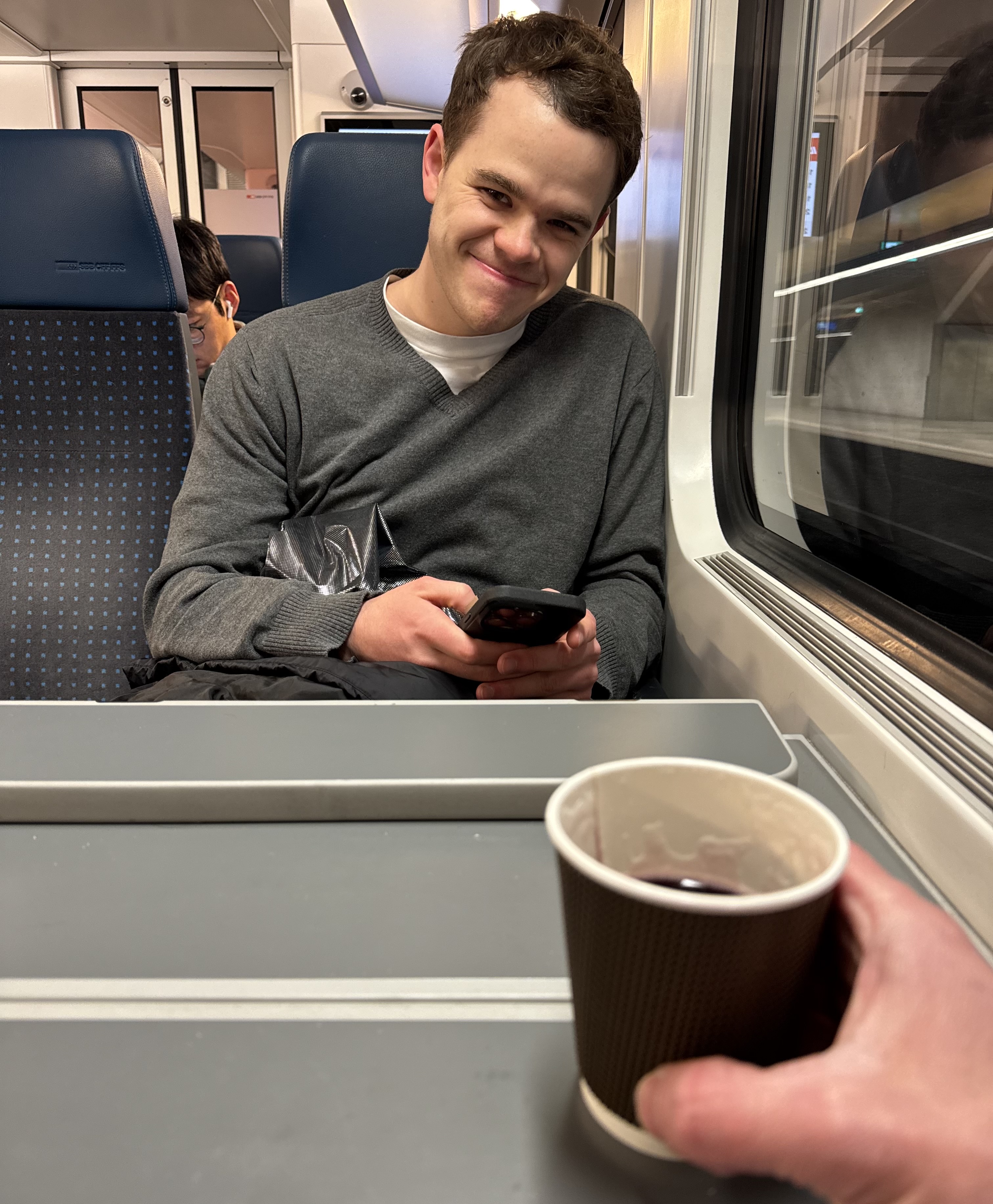
I would always complain to Andy back home that Switzerland was insanely expensive. Andy always had the same answer: “You pay for quality in Switzerland. That’s why everything is so expensive.” I would always laugh. Throughout the trip, I would really understand what he meant.
Caleb’s brother John picked us up at the train station in Bern and drove us to the family’s house, which is just outside the city center. It is one of those preserved farmhouses that is roughly 500 years old, and from the moment you see it you understand why the Swiss talk about their houses the way they do. The exterior is beautiful in the lived-in way that only centuries of care can produce, and the interior is even better. John’s wife Marlin and their four kids welcomed us in like family. Marlin grew up in Switzerland but also lived in the US for a long stretch as an adult, which made her one of the best perspectives I had on either country. Almost every night that week, the six or seven of us would have a Swiss meal together, play cards with the kids, and after the kids went to bed, the adults would sit with wine and chocolate and talk about Switzerland, the US, and life in general. I learned more about Switzerland at that dinner table than I did in any museum.
The house, for instance, is heated by a wood-burning oven. I kept hearing the wood crack and momentarily panic that we’d left a stove on, only to remember that the entire heating system is fire-based. I was told that to replace it with something more modern, you would need government approval. You’d also need government approval to swap out the windows. That sounded crazy to me as an American at first. Where I’m from, your house is yours and you do what you want with it. But John and Marlin explained it in a way that made sense. Switzerland is a small country with very limited land, and the buildings, the trees, and the landscapes are part of the national patrimony in a way they are not in the US. We have so much land in the US that we can afford to be casual with it. Switzerland cannot. The result is that Switzerland has the reputation of being one giant HOA, but it is also the reason houses like John and Marlin’s still exist after five centuries, and the reason recycling laws are stricter, and a big reason the country looks as beautiful as it does.
Real estate in Switzerland is wildly expensive, but it also makes more sense than it first appears. Mortgage rates can be as low as 1%, which means a 1 million franc house costs you around 10,000 francs a year in interest. That is cheaper than most Americans pay in rent for far worse housing.
Bern itself is gorgeous. It is the kind of city I would seriously consider living in. Everything is preserved, the streets are walkable, and the medieval old town is laid out so well that you do not notice how tall the city is until you’re on it. Caleb and I were walking along a perfectly normal-looking street when I glanced over a ledge and realized we were about ten stories above another part of the city. The bear park (the bear is the symbol of Bern, and the city flag has one on it) was great. We also walked through one of the city’s Christmas markets, which was the first of many. December in Switzerland is essentially one big rolling Christmas market across every city you visit, and after a while you start expecting Glühwein (mulled wine) and roasted chestnuts in every public square.
Walking around Bern, you start to notice how rarely strangers strike up conversations with each other. It is one of those things that took me a few days to clock. Everyone is polite and helpful when you ask them something directly, but no one is just chatting in line or commenting on the weather or trying to make a friend. I asked Marlin one night what she thought the biggest problem in Switzerland was. She said mental health and suicide. That genuinely surprised me. How could one of the most functional, prosperous countries in the world have a mental health crisis? My guess, after thinking about it for a while, is that Switzerland might be too efficient for its own good. People tend to form friendships in moments of friction. Standing in a line that was moving too slowly. Waiting for a delayed train. Stuck in a class registration system that is not working. Those inefficiencies are also the moments humans accidentally start talking to each other. Switzerland has engineered most of those moments out of daily life. The trains are on time. The systems work. You do not have to chat with the person next to you because the system has already taken care of whatever you needed. Germans have to deal with constant administrative friction, and I think that friction has social benefits no one credits. John recommended a video to me called “How to Make Friends with a Swiss Person” (link). Honestly, none of my Swiss friends truly match the description in the video as they are very warm and personable. But every Swiss person I have shown the video to has laughed and said it is very accurate.
Let me tell you about the trains, because they might be the single most Swiss thing in the country. The SBB app plans your trip with transfers timed down to the minute. You can take a train from a station near John and Marlin’s house, transfer at Bern Hauptbahnhof to a train to Zurich, transfer in Zurich to a train to Lugano, and the SBB app will route you with five-minute layovers. The trains run so punctually that this actually works. If a train is even three minutes late, however, you can miss your connection and lose half an hour or more. My dad once told me a story from a work trip to Zurich where a Swiss rail employee approached him on the platform to formally apologize for a delay. My dad asked how long. She said three minutes. My dad burst out laughing. The first time I heard the story I thought it was ridiculous. After a week of riding Swiss trains, I started getting genuinely frustrated when a train was three minutes late. I started to understand the rail employee from my dad’s story.
The trains are extremely expensive even for Swiss people, which I found surprising. Switzerland could easily subsidize rail tickets out of tax revenue. I think the high prices are intentional. Keep prices high and you keep crowds manageable, you keep pickpockets out (what is the ROI for a pickpocket on a one-hour, seventy-dollar train), and you keep the system from being slowed down by the kinds of problems that plague public transit in the rest of Europe. Fewer disturbances means fewer delays. Fewer delays means the entire network keeps running on time. It also might be one of the subtle ways Switzerland keeps itself separate from the EU countries surrounding it. (Fun fact: Switzerland is not in the EU, and in my opinion they should keep it that way.)
The trains are so nice they even have bathrooms. A word of warning: the doors are automatic. There is a button you press to open them, and another to lock them once you are inside. One day on a train I was not sure if the bathroom was occupied. I asked the guy next to me if anyone was in there. He said he wasn’t sure. I was about to press the button to open the door when another guy out of nowhere walked up and pressed it before me. The door flew open, and a young woman was sitting on the toilet. She yelled “Heyyy!” The worst part is that the door closes significantly slower than it opens. I felt so much secondhand embarrassment I decided not to use the bathroom at all and go back to my seat. Caleb asked how I had gone so fast. I told him what happened, and he laughed. The lesson: always lock the bathroom door on Swiss trains.
Caleb and I had our Swiss travel passes, and we intended to use them. We started with Gruyères, which was a perfect first day trip. With our travel passes we got a free tour of the Cailler chocolate factory, where they walk you through the history of the company and let you sample as much chocolate as you can stand at the end. The level of automation was wild. Also worth noting: Switzerland cannot grow cocoa. You cannot grow it anywhere near this latitude. The fact that Switzerland is internationally known for chocolate, while not producing a single bean of its primary ingredient, is one of the great branding feats of the last two centuries. After Cailler we walked over to La Maison du Gruyère, the cheese factory, where the travel pass got us a free tour and free cheese. We finished the day with warm Glühwein in the village square. Highly recommend.
I love languages, and Switzerland is the European jackpot. The country has four official languages: German, French, Italian, and Romansh. I had studied the first three, so each day-trip became a chance to practice. I would ask Caleb if I could order our food or buy our tickets in whatever language was local. Caleb and I would also bet on whether the person I spoke to would respond to me in that language or just switch to English. The Swiss are so multilingual that most of the time they switched to English, which was always kind of funny. On the rare occasions they replied in the local language, I would stand there trying to keep up and sometimes get totally lost. Caleb would ask what they had said, and half the time I had to shrug. That was part of the fun. Poor Caleb having to put up with me.
Swiss German is its own beast. I think Swiss German and standard High German are genuinely more different than Spanish and Portuguese, or Russian and Ukrainian, even though they technically share the same name. There is no official written form of Swiss German, and the dialect can change significantly from one canton to the next. I once heard that two Swiss German speakers from different cities will sometimes switch to English over text because they cannot reliably parse each other’s written Swiss German. (Maybe that is why you can legally marry a first cousin in Switzerland. I joke. Kinda.) I would speak High German to the Swiss and they would understand me, but when they spoke back in Swiss German I was lost. Swiss German sounds a lot like redneck German if you ask me, but I’m sure that opinion is controversial. At work, Andy told me he spoke three languages: English, Swiss German, and standard High German. I made fun of him and said I spoke twenty: American English, Australian English, Canadian English, and so on. He tried to explain that Swiss German and High German were genuinely different languages. I did not believe him at the time. Now I do. Andy, you were right, you really do speak three languages.
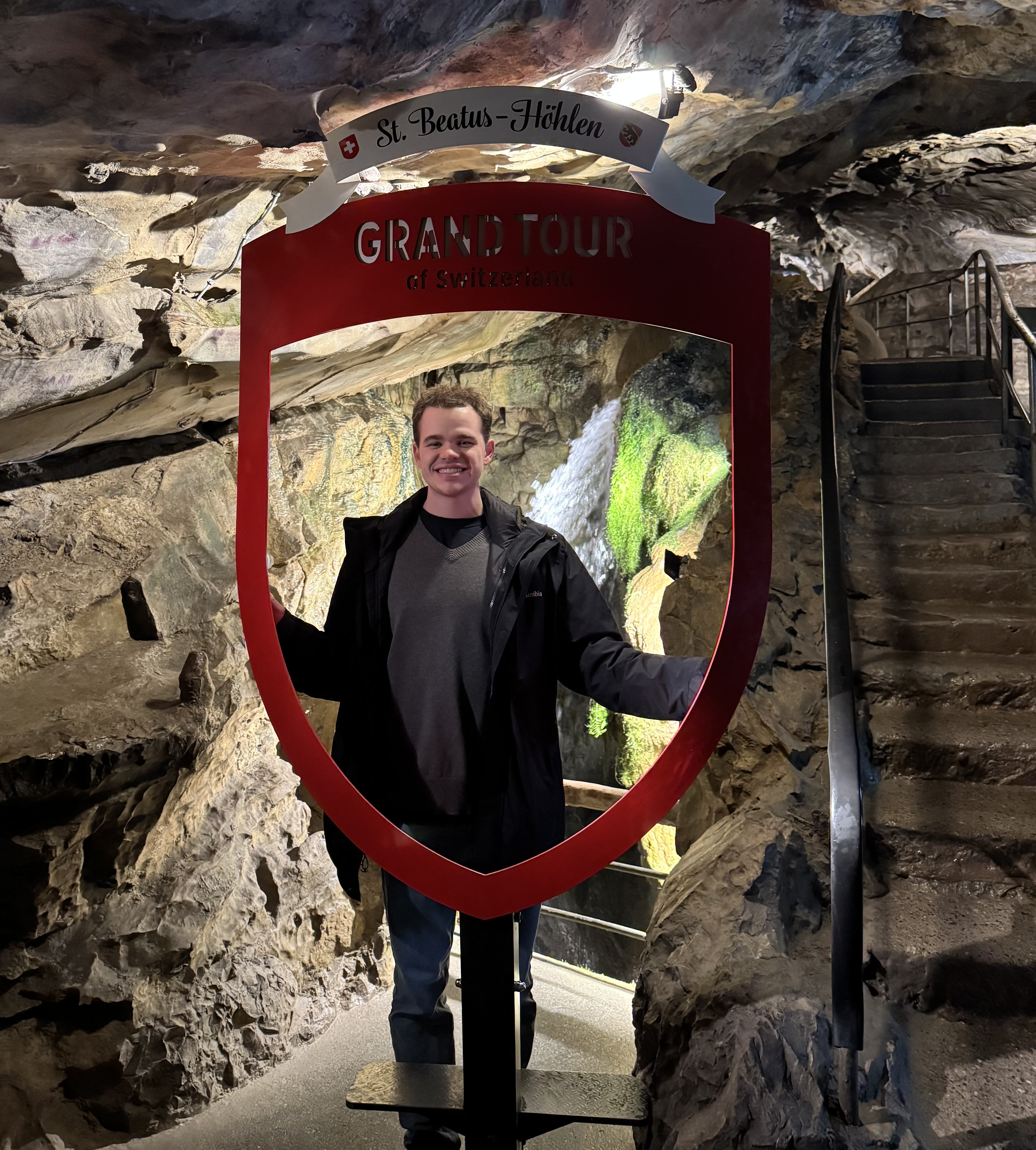
The day after Gruyères we went to Thun. We took a boat ride on Lake Thun (covered fully by the travel pass) and did a cave tour at St. Beatus-Höhlen. The moist air in the caves was unexpectedly good for my sinuses, which had been wrecked by the cold December weather.
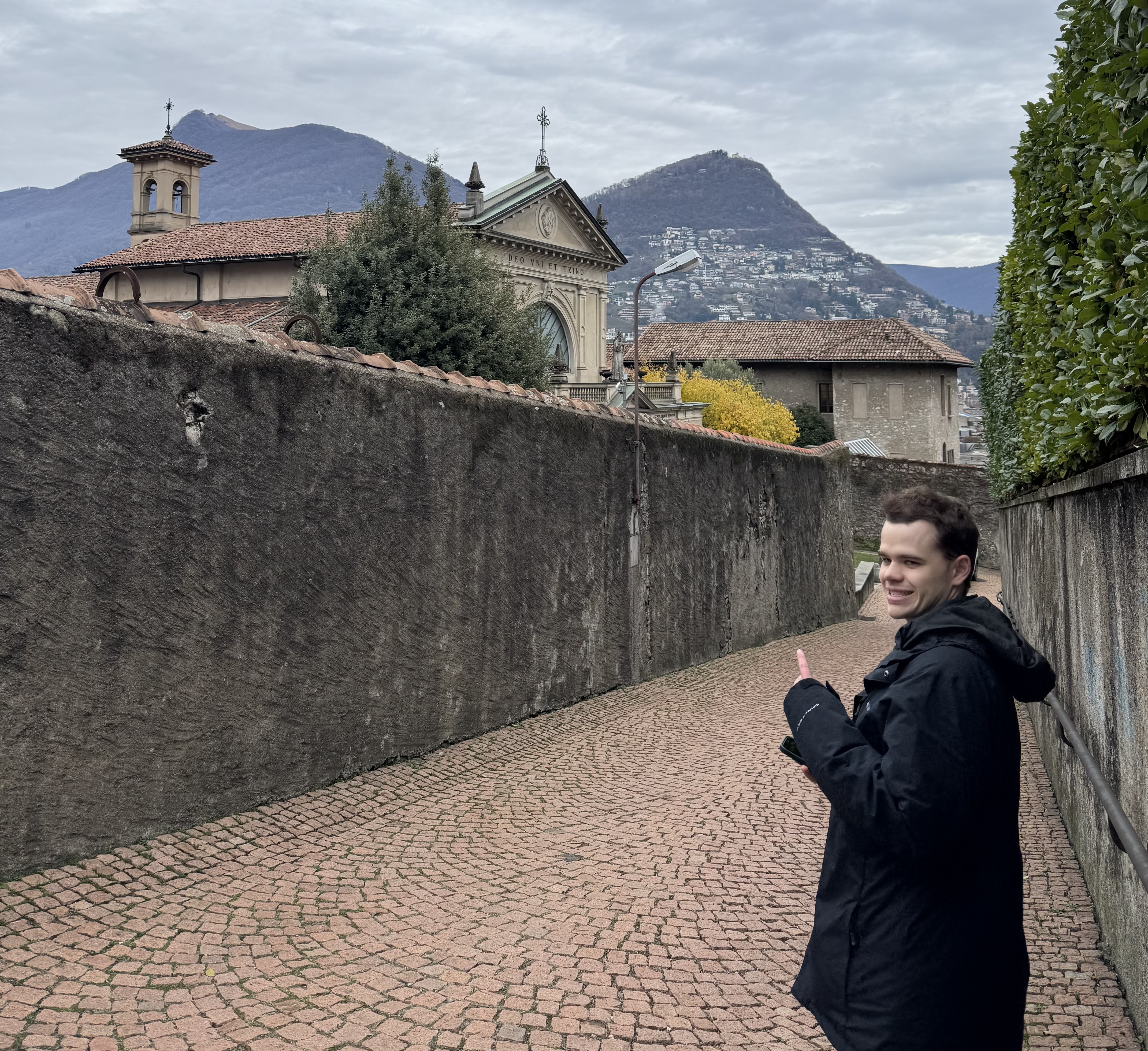
The day after that we went to Lugano, in the Italian-speaking part of the country. From Bern you can reach essentially anywhere in Switzerland in three hours or less, which still feels insane to me. In Lugano we saw a castle in Bellinzona and grabbed lunch at a pizza place called Pio Pio, where I ordered in Italian and the owner was so delighted that an American was trying to speak Italian that he gave Caleb and me a free pizza. From Lugano we took a bus to Campione d’Italia, a small town that is technically Italian territory but is completely surrounded by Switzerland. So I can now say I have been to Italy for exactly one hour.
The main thing in Campione is a giant casino. We went in, the staff said they needed to scan our passports, the scanner broke immediately, and the difference between Swiss and Italian quality was immediately on display. They eventually let us in with a 10 euro signup credit. We burned through it in about ten minutes, and we caught the bus back to Switzerland.
The evenings back at John and Marlin’s were some of the best parts of the week. We would come home from a day trip and John and Marlin would prepare a Swiss dinner. Raclette, where you melt cheese and scrape it onto potatoes with various toppings, was great. Fondue night was always an experience for the kids. They would dip bread, mushrooms, and (this part is real) bananas into the cheese, then swirl the food in the pot before eating. So delicious. I do not have the dairy tolerance of a Swiss child, so I just dipped without swirling. My personal favorite was something I had never heard of before: alpine mac and cheese.
One night before dinner, I was speaking with Marlin about Swiss culture and politics. One of the most interesting conversations was about a Swiss referendum a few years ago on universal basic income. The proposal would have paid every adult resident roughly 2,500 francs per month, no strings attached. Marlin said when she described the idea to an American friend, the friend’s immediate reaction was that voting for it would be a no-brainer. Marlin and the majority of the country voted against it. The proposal got rejected with about 77% of the country voting no. I think this points to a deeper difference between Swiss and American government. In the US, the federal government is so large and so abstracted from the average person that people often see it as a vague entity they should try to extract as much from as possible. In Switzerland, where the political units are smaller and direct democracy is constant, that abstraction is gone. People understand that the government’s money is their money. If the canton starts paying everyone a basic income, that has to come from somewhere, and that somewhere includes you. Especially if you want to keep inflation near zero, which Switzerland does. Once you understand the trade-off concretely, free money is no longer such a no-brainer.
After Lugano, Caleb and I went to Zurich for a day. Doner kebabs, ETH Zurich, a technology museum, and a stroll down Bahnhofstrasse where we made it our mission to find the most expensive watch in any window display (the winner was over 100k francs). We also walked through Langstrasse, which is technically the “rough” part of Zurich. By any global standard, “rough” Zurich is nicer than the average American suburb.
We hit another Christmas market where they were handing out free Lindt truffles. I love this country.
The next day we went to Luzern, stopping on the way at the Kambly cookie factory. Kambly does samples in a way that suggests they have given up trying to control how much you eat. Caleb and I ate enough cookies that morning to skip lunch. In Luzern, we saw the famous covered wooden bridge, walked through the city, and headed back.
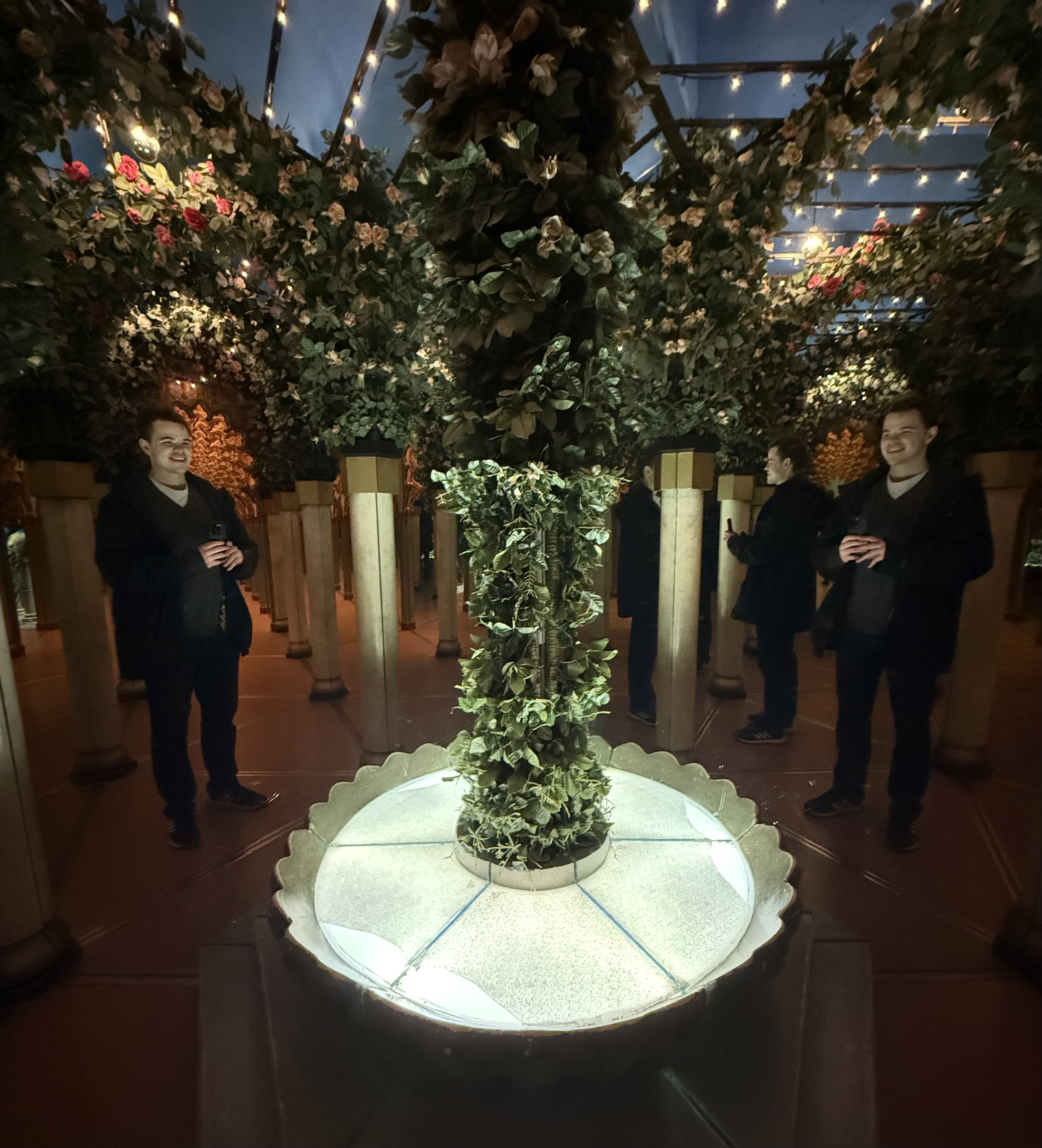
That was the end of Caleb’s week. We had spent seven days traveling the country together, eating chocolate and cheese and Lindt truffles, sampling cookies until we were sick of them, and visiting museums, caves, castles, and delicious Swiss food factories. I was really grateful to have been able to travel with Caleb. There is something about traveling with someone for a full week that compresses a lot of friendship into a small amount of time. I also said goodbye to John, Marlin, and the kids that night. Staying with them taught me more about Switzerland than any guidebook ever could.
That night I took a train to Zofingen to meet Andy. He picked me up at the train station and offered to grab my bags. Then he saw I had brought one backpack. Andy said “Well, I guess it’s best to travel light anyway.” I asked if I could do laundry at his place. He said yes.
Andy’s house was beautiful. Modern and well-built. He set me up in their guest room. I caught up with him about everything in Lafayette and he caught me up on his life in Switzerland. He had started a new role at GE about six months earlier and was already being promoted. His wife Sarah is a veterinarian who worked at Purdue’s vet school. She now works at a different vet hospital and still helps host Purdue vet students for rotations in Switzerland. She is also one of the kindest and most hospitable people I met. If you are a vet student reading this, do the Switzerland rotation. I also got to see Andy and Sarah’s two young kids. The youngest had not been walking yet when they left Indiana, and now he was walking everywhere. It was crazy to see him grow so much.
Staying with Andy got me thinking about why people like him end up moving back. Switzerland is a huge winner of the brain drain. Part of why the country attracts and keeps so many talented people is that the quality of life is high, jobs pay well, the franc is extremely strong, and tax rates are reasonable compared to neighbors like France and Germany. If you are a top earner in Germany getting taxed at over 50%, why wouldn’t you move 200 miles south, keep more of what you earn, and live in a country with better public infrastructure and lower inflation? No wonder so many brilliant people end up in Zurich, Geneva, and Lausanne. Andy himself faced exactly that question. He had a great job in Indiana, a good life, and friends. But the math of raising a family in Switzerland versus the US, in terms of healthcare, education, public safety, and overall quality of life, was hard to argue with. I get it now.
After having visited the country for a week, I thought it would be fun to move to Switzerland too. But getting into Switzerland legally as an American is the hard part. You essentially have three ways to get in. You prove you have a skill no Swiss or EU citizen can provide, get a golden visa (around a million-franc investment), or marry a Swiss citizen. I would love to live, work, or study in Switzerland, but the path is essentially closed to Americans. The easiest route would be to marry a Swiss girl. My email is at the bottom, ladies.
The other thing that became clearer to me was the role of education. Caleb told me earlier in the week that everything in Switzerland is expensive except for education. Higher education is heavily subsidized, and that one fact ripples through the whole country. Watching how Andy and Sarah think about raising their kids here, with access to a world-class public school system and one of the strongest research university networks in the world, made the point land. I have come to believe that almost every major problem we have in the US traces back, at root, to education. Healthcare crisis? Educate people more on health and wellness. Personal debt crisis? Educate people on finances. Political polarization? Educate people on civics and history. I am increasingly going to vote for candidates who prioritize making education more accessible, because I have seen what it does for a country that takes it seriously.
The next morning Andy and Sarah went to work, and I went back to exploring on my own. I took a day trip to Andy and Sarah’s hometown of Schaffhausen, where I saw the Munot fortress and the Rhine Falls. Sarah had recommended I also walk over to Stein am Rhein, where she actually grew up. It is a perfectly preserved medieval town with painted facades on every building in the old square, and you should absolutely walk through it if you ever find yourself in the area.
The day after, I went to Basel, partly because I wanted to pay homage to my favorite mathematician of all time, Leonhard Euler. Switzerland literally puts Euler’s face on currency. He was born in Basel. I found Euler’s sculpture at the University of Basel and walked Leonhardstrasse, but I was honestly a little disappointed that there is not more of a museum or shrine. The man invented half the math we use today. I also visited the Bernoulli house, since the Bernoullis were also in Basel. The Paper Museum in Basel was a highlight of the day. I got to make my own piece of paper and walked through the evolution of typewriters and printing presses. I also visited the Museum Tinguely, which is dedicated to weird mechanical sculptures that move when you press buttons. Weird, but cool.
That night I got back from Basel and had dinner with Andy, Sarah, and the kids. Andy mentioned he had a business trip to India early the next morning and asked if I could drop him off at the Zurich airport. We drove out, I thanked him for everything, and told him I would see him next time. When we got to the airport, he handed me the keys to his car so I could drive it back to his house. I had never driven outside the US before. “Don’t crash,” he said. “But if you do, I guess that’s why we have insurance.” Andy is always hilarious like that. I drove back fine. Sarah was kind enough to host me for the last two days.
The next morning I went to Lausanne, where I visited the Olympic Museum, the Sauvabelin Tower, and the art museum, and had an expensive but delicious doner kebab. On the way back, my dad texted me suggesting I spend my last day in Geneva, specifically at CERN. So I went.
CERN was incredible. I got there as early as I could and booked one of their free guided tours. The history of the place, the particle accelerator, the people who have worked there, the way the science of the last hundred years has flowed through that one campus. It was a perfect last-day-in-Switzerland kind of experience. After CERN I visited the Red Cross Museum (also founded in Switzerland by a Swiss businessman named Henry Dunant in 1863). Geneva was the most diverse Swiss city I visited by a wide margin, and also the city where I saw the most visible struggle. There were noticeably more people in obvious crisis on the streets than anywhere else I had been. By the end of the day, I was exhausted. I think Geneva was my eleventh city of the trip. I trained back to Zofingen, thanked Sarah, grabbed my bag, and took the train to the airport.
I had spent years telling Andy that Switzerland was too expensive, too far, and too complicated. He kept telling me to go anyway. I’m so glad he convinced me. Two weeks in his country gave me a deeper understanding of what he had been trying to explain to me at the office for years. Why he is the way he is. Why his work ethic is what it is. Why he kept saying you pay for quality. And the trip gave me something else I did not expect, which was a reminder that the real reason to travel is not always the places you see. Sometimes you learn the most from the people you meet and friends you travel with. Without Caleb, without John and Marlin and their family, without Andy and Sarah and the kids, this would have been a different trip and a much less impactful one. I came back from Switzerland with a deeper appreciation for their culture and the Swiss people. I owe Andy at least one more visit. Hopefully it will be more than one. .